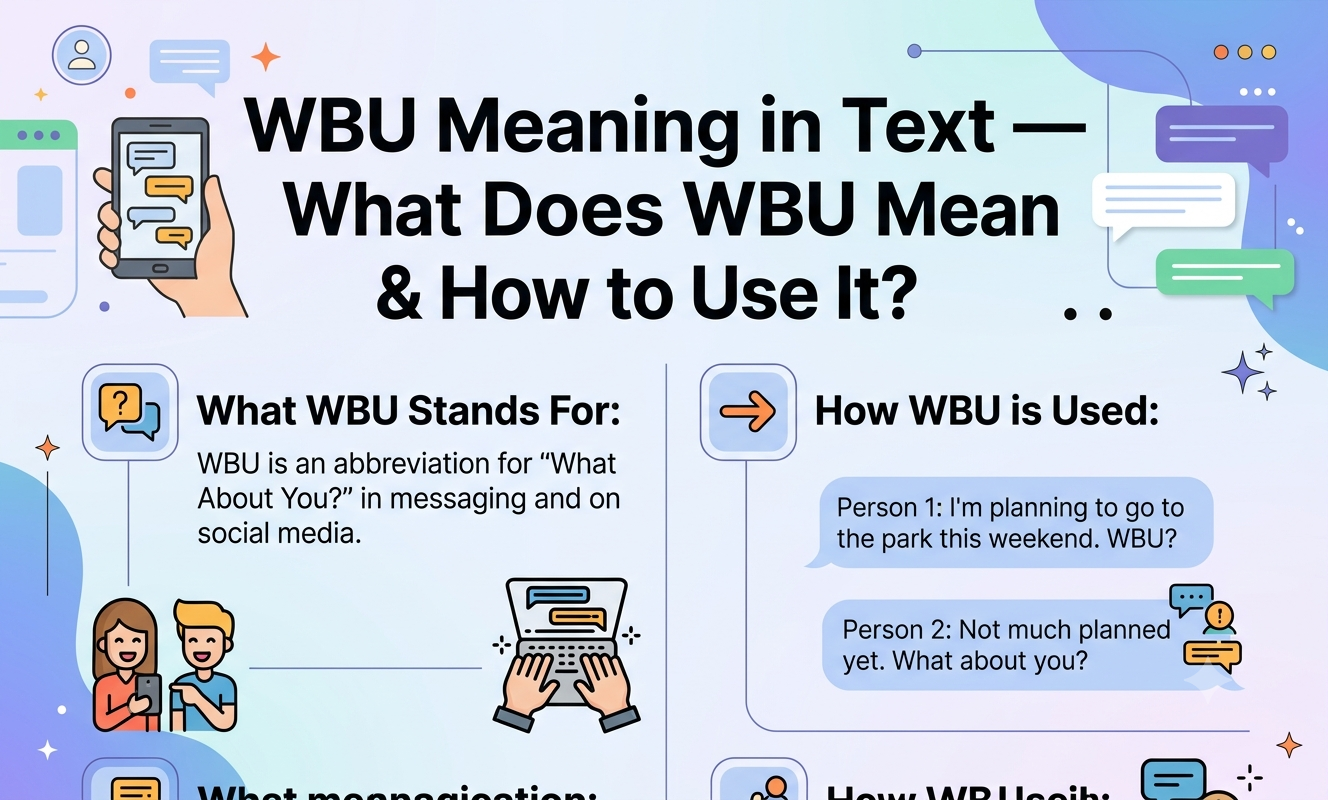
Quick Answer: WBU stands for “What About You?” It’s a casual texting abbreviation people use right after answering a question, so the conversation naturally flows back to the other person. For example: “I’m doing good, wbu?” It’s common in DMs, group chats, and comment replies across nearly every messaging app.
Introduction
Ever gotten a text that just says “good, wbu?” and had to pause for a second to figure out what it meant? You’re not alone. WBU meaning in text is one of those small abbreviations that shows up constantly in everyday chats but rarely gets explained anywhere.
Once you know it, you’ll start noticing it everywhere — in WhatsApp replies, Snapchat streaks, Instagram DMs, and TikTok comment sections. It’s short, casual, and genuinely useful because it keeps a conversation going without sounding forced.
In this guide, you’ll learn exactly what WBU means, where it came from, how to use it naturally, whether it’s considered rude in any context, and how to reply when someone sends it to you. We’ll also cover how it shows up differently across platforms in 2026, plus a list of similar texting shortcuts you’ll probably want to know too.
What Does WBU Mean?
WBU stands for “What About You?” It’s used to redirect a question back to the person you’re talking to, usually right after you’ve answered something they asked.
A typical exchange looks like this:
- Friend: How was your weekend?
- You: Pretty chill, just stayed home. WBU?
Instead of typing out the full phrase “what about you,” people shorten it to keep the chat quick and casual. This kind of abbreviation became common as texting and instant messaging replaced phone calls as the default way people communicate, especially among teens and young adults.
WBU isn’t a brand-new term. It’s been part of texting culture for years, growing alongside other classic abbreviations like LOL, BRB, and TTYL. What’s changed heading into 2026 is where it shows up — it’s less about SMS text messages now and much more common in app-based chats, voice-to-text captions, and even short-form video comments, where quick, low-effort replies keep conversations moving fast.
WBU Full Form Explained
WBU is a simple acronym. Here’s the letter-by-letter breakdown:
| Letter | Stands For |
|---|---|
| W | What |
| B | About |
| U | You |
Put together, it reads: “What About You?” — a short, friendly way of asking someone to share their own answer after you’ve shared yours.
You’ll sometimes see it written in different cases (WBU, wbu, Wbu) — casing doesn’t change the meaning. It’s almost always lowercase in casual texting.
How to Use WBU — Real Examples
WBU works in almost any casual conversation where you want to turn the spotlight back to the other person. Here are examples across different emotional contexts.
| Situation | Example | Emotion |
|---|---|---|
| Catching up with a friend | “Just got back from the gym, wbu?” | Neutral / Casual |
| Checking on someone’s day | “Today was rough, so many exams. wbu, how was yours?” | Stressed |
| Talking about weekend plans | “Thinking of watching a movie tonight, wbu?” | Relaxed |
| Responding to good news | “I’m doing great, just got some good news! wbu?” | Happy |
| Comforting a friend | “I’m okay, just tired. wbu, you good?” | Tired / Caring |
| Flirty conversation | “Missing you a bit ngl, wbu?” | Affectionate |
| Group chat check-in | “I’m free this weekend, wbu guys?” | Casual / Inclusive |
| After a tough day | “Kinda stressed about work, wbu?” | Anxious |
| Small talk with a new contact | “Just relaxing at home, wbu?” | Neutral |
| Excited conversation | “I just booked my trip!! Wbu, any plans?” | Excited |
Notice how WBU fits comfortably into almost any tone — happy, tired, stressed, or flirty. That flexibility is exactly why it’s stuck around in texting culture for so long.
WBU on Different Platforms (2026)
WBU shows up differently depending on the app you’re using. Messaging habits have shifted a lot in recent years, with more conversations happening through disappearing messages, voice notes, and quick comment replies rather than long text threads. Here’s how WBU fits into each major platform today.
On WhatsApp
WhatsApp remains one of the most popular messaging apps worldwide, and WBU is common in both one-on-one chats and group conversations. Because WhatsApp threads often mix voice notes, texts, and stickers, WBU frequently appears at the end of a quick typed reply sandwiched between voice messages — a fast way to keep the exchange going without recording another voice note.
On Snapchat
Snapchat’s culture revolves around quick back-and-forth chats and streaks, which makes WBU a natural fit. Since Snapchat conversations are often short bursts rather than long paragraphs, “wbu” is an efficient way to keep a streak-chat or DM feeling active without much typing effort.
On TikTok
On TikTok, WBU shows up less in direct messages and more in comment sections and replies to comments. Someone might comment “I’m using this song for my trip video, wbu?” under a trending sound, turning a comment into a mini conversation with other users.
On Instagram
Instagram DMs and comment replies both use WBU frequently, especially among close friends chatting through Stories replies. It’s also common in Instagram group chats, where quick check-ins (“just chilling, wbu?”) keep the conversation casual and low-pressure.
Across all these platforms, the core meaning of WBU stays exactly the same — only the setting changes. What’s consistent in 2026 is that shorter, faster texting shortcuts like WBU continue to thrive because conversations increasingly happen in quick bursts rather than long typed-out messages.
Is WBU Rude or Offensive?
No, WBU is not rude or offensive in any typical context. It’s simply a shorthand way of asking “what about you,” and it’s used the same way people would ask that question out loud in conversation.
Why some people might feel it’s a bit dismissive:
If someone answers a heartfelt or serious message with just “wbu” and nothing else, it can feel a little low-effort or dismissive — not because of the word itself, but because of how briefly it’s used. For example, replying “wbu” to a message where someone shared something emotionally difficult might come across as not fully engaging with what they said.
Why it’s usually totally fine:
In casual, everyday chats, WBU is completely normal and even expected. It shows the person is still interested in the conversation and wants to know about your side of things too. Context matters more than the abbreviation itself — a warm “wbu?” after a caring response feels friendly, while a flat “wbu” after ignoring someone’s feelings can feel abrupt.
The simple rule: match the abbreviation to the tone of the conversation. If the topic is light, WBU is perfectly fine. If it’s something more serious, it helps to add a sentence around it.
How to Reply to WBU
Not sure how to respond when someone sends you “wbu”? Here are a few natural ways to reply depending on the mood of the conversation.
| Their Message | Your Reply Option | Tone |
|---|---|---|
| “I’m good, wbu?” | “I’m doing well too, just relaxing at home.” | Casual |
| “Kinda tired today, wbu?” | “Same here honestly, long day for me too.” | Relatable |
| “Excited for the weekend, wbu?” | “Me too! Thinking of going out with friends.” | Enthusiastic |
| “Not much, just studying. wbu?” | “Same, trying to finish an assignment.” | Neutral |
| “Feeling a bit down, wbu?” | “Sorry to hear that. I’m okay, want to talk about it?” | Caring |
| “Just got home, wbu?” | “Still at work, wrapping up soon!” | Informative |
A good reply usually mirrors the energy of the original message — matching a caring tone with care, and a casual tone with something equally light.
WBU Alternatives and Similar Slang
WBU isn’t the only shorthand people use to redirect a question. Here are other common alternatives you’ll likely come across.
| Abbreviation | Meaning |
|---|---|
| HBU | How About You |
| WYD | What You Doing |
| SUP | What’s Up |
| HRU | How Are You |
| WYA | Where You At |
| TTYL | Talk To You Later |
| NM | Not Much |
| GTG | Got To Go |
HBU (“How About You”) is essentially interchangeable with WBU — both are used the same way, just phrased slightly differently. Which one someone uses often just comes down to personal texting habit rather than any real difference in meaning.
Frequently Asked Questions (FAQ)
Q: What does WBU mean in a text message? A: WBU means “What About You?” It’s used to ask the other person the same question they just asked you, keeping the conversation flowing.
Q: Is WBU the same as HBU? A: Yes, WBU (“What About You”) and HBU (“How About You”) are used interchangeably in casual texting. Both redirect a question back to the other person.
Q: When should I use WBU in a conversation? A: Use WBU right after answering a question someone asked you, when you want to know their answer too — for example, “I’m good, wbu?”
Q: Is it okay to use WBU with someone I don’t know well? A: Yes, WBU is casual and friendly enough for both close friends and new contacts. It works well in everyday small talk.
Q: Does WBU mean something different on Snapchat or TikTok? A: No, WBU means the same thing across every platform — WhatsApp, Snapchat, TikTok, and Instagram. Only the setting (DMs vs. comments) changes, not the meaning.
Q: Can WBU be used in a professional or formal message? A: It’s best to avoid WBU in formal or professional messages. Spelling out “What about you?” reads more polished in emails or workplace chats.
Conclusion
WBU is one of the simplest and most useful texting abbreviations out there — a quick way to say “what about you?” without slowing down the conversation. Whether you’re chatting on WhatsApp, replying to a Snapchat streak, commenting on TikTok, or messaging on Instagram, WBU meaning in text stays consistent: it’s a friendly nudge that keeps the conversation two-sided.
Now that you know what it means, how to use it, and how to reply to it, you’ll never have to pause and wonder again the next time it pops up in your messages. Bookmark this page so you always have a quick reference for WBU and similar texting slang.
Also read 92 Inches in Feet: 92 Inches = 7.67 Feet