Quick Answer Box
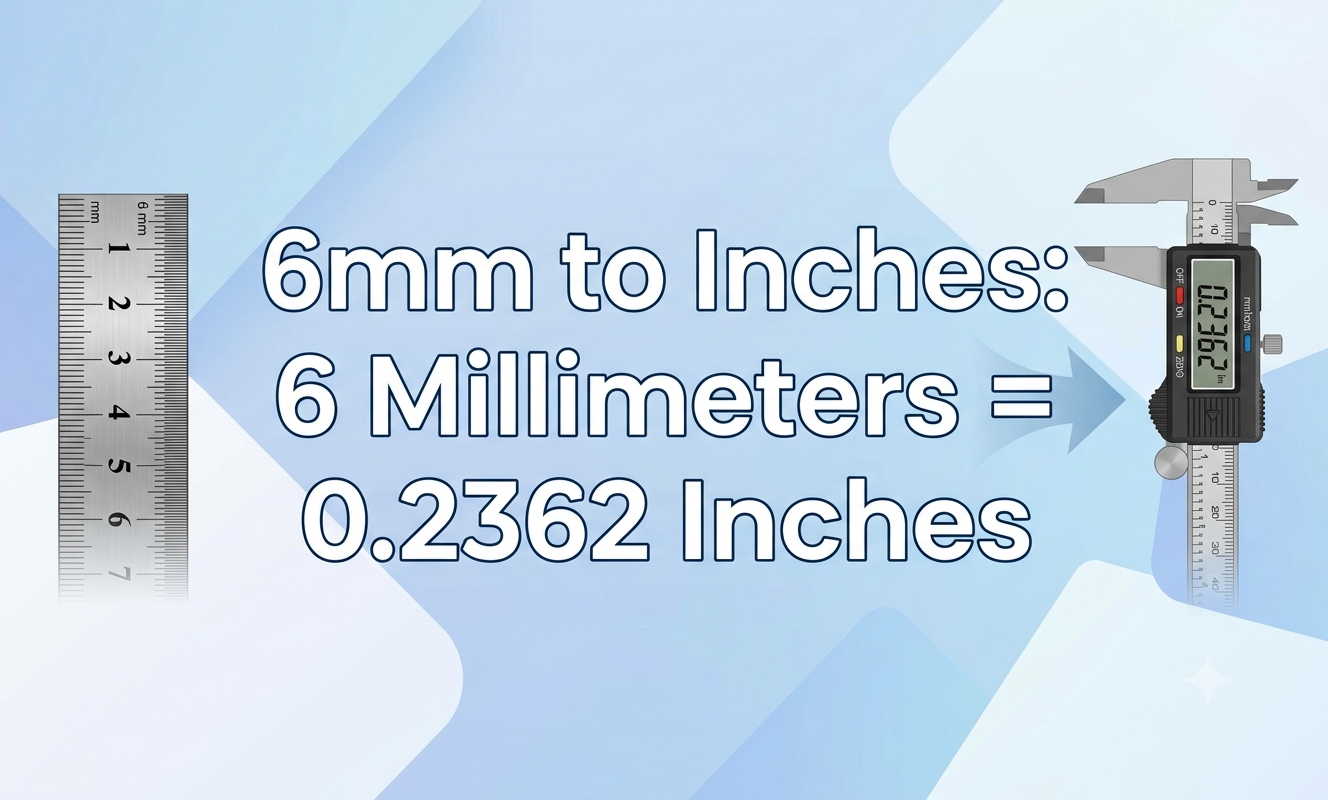
6 mm = 0.2362 inches
- Decimal: 0.2362 in
- Fraction (approx): 15/64 in
- Feet + Inches: 0 feet, 0.2362 inches
- Formula: 6 ÷ 25.4 = 0.2362 inches
What is 6mm to Inches?
6 millimeters equals 0.2362 inches, or roughly 15/64 of an inch. Millimeters (mm) are part of the metric system used in most of the world, while inches belong to the imperial system used mainly in the United States, UK, and Canada. This conversion comes up constantly — when buying jewelry, checking drill bit sizes, reading technical drawings, or shopping for hardware. Knowing that 6mm is just under a quarter inch helps you make faster, smarter decisions without needing a ruler every time.
How to Convert 6mm to Inches
There is one simple rule: 1 inch = 25.4 millimeters. Use that to convert any millimeter value to inches.
Method 1 — Divide by 25.4 (mm → inches)
6 ÷ 25.4 = 0.23622 inches
Method 2 — Multiply by 0.03937 (the inch-per-mm factor)
6 × 0.03937 = 0.23622 inches
Both methods give the same result. Method 1 (dividing by 25.4) is easier to remember because 25.4 is the exact conversion factor defined by international standards. Round to 0.2362 inches for most practical uses, or keep it as 15/64″ if you’re working with a standard imperial ruler.
Quick mental shortcut: 6mm is just a tiny bit less than 1/4 inch (0.25 in). If you need a rough estimate, “just under a quarter inch” works fine.
Real-World Examples: What Does 6mm Look Like?
Understanding the size of 6mm helps you visualize this measurement without a ruler.
A standard pencil eraser The pink eraser on the end of a typical school pencil is about 6mm thick. If you’ve ever used one, you already know exactly how big 6mm is.
A pea or small blueberry A medium-sized pea or a small blueberry is right around 6–7mm in diameter. This is one of the easiest food-based size references for 6mm.
Common jewelry stone size In rings and earrings, a 6mm gemstone (like a round diamond or cubic zirconia) is a very popular, classic size — small enough to be delicate, large enough to be noticed. Jewelers reference this size constantly.
A drill bit for woodworking A 6mm drill bit is one of the most common sizes in metric tool sets. It creates a hole just under 1/4 inch — perfect for dowels, pilot holes, and cabinet hardware.
USB-A port thickness The metal housing of a standard USB-A connector is roughly 6–7mm tall. Next time you plug in a USB drive, that’s your 6mm reference.
A standard AAA battery cap The metal cap/terminal on a AAA battery is approximately 6mm across. Compact, but clearly visible — another easy daily-life reference.
Practical Use Cases
DIY & Home Improvement
When drilling holes for cabinet hinges or shelf pins, 6mm is a go-to drill bit size in metric tool sets. It produces a hole that is just under 1/4 inch — critical when following assembly instructions from European furniture brands like IKEA that use metric measurements. If your blueprint calls for 6mm holes and your drill press shows inches, you know to set it just under the 1/4″ mark (which is 6.35mm).
Fashion & Jewelry / Shopping
6mm is one of the most popular gemstone diameters in jewelry making. A 6mm round gemstone sits perfectly in a classic solitaire ring without being too bold or too subtle. When buying earring studs, pendants, or beads online — especially from international sellers — sizes are listed in mm. Knowing that 6mm ≈ just under 1/4 inch helps you judge if a piece will look right before it arrives.
School, Science & Math
In science class and technical drawing, measurements are given in millimeters. If your assignment asks you to draw a line 6mm long and your ruler only shows inches, mark it just short of the 1/4 inch mark (since 1/4 inch = 6.35mm, and 6mm is slightly less). This kind of practical metric-to-imperial conversion is a core skill tested in middle and high school STEM classes.
Nearby Conversions Table
| Millimeters (mm) | Inches (decimal) | Inches (fraction) | Feet |
|---|---|---|---|
| 1 mm | 0.0394 in | 3/64 in | 0.003 ft |
| 2 mm | 0.0787 in | 5/64 in | 0.007 ft |
| 3 mm | 0.1181 in | 1/8 in (approx) | 0.010 ft |
| 4 mm | 0.1575 in | 5/32 in | 0.013 ft |
| 5 mm | 0.1969 in | 13/64 in | 0.016 ft |
| 6 mm | 0.2362 in | 15/64 in | 0.020 ft |
| 7 mm | 0.2756 in | 9/32 in | 0.023 ft |
| 8 mm | 0.3150 in | 5/16 in | 0.026 ft |
| 9 mm | 0.3543 in | 23/64 in | 0.030 ft |
| 10 mm | 0.3937 in | 25/64 in | 0.033 ft |
| 11 mm | 0.4331 in | 7/16 in (approx) | 0.036 ft |
Frequently Asked Questions
Q: How many inches is 6mm? A: 6mm equals 0.2362 inches, or about 15/64 of an inch. This is just slightly less than 1/4 inch (which is 6.35mm). For most practical purposes, you can think of 6mm as “just under a quarter inch.”
Q: What is 6mm in fraction inches? A: The closest standard fraction is 15/64 inch. In general use, many people round this to 1/4 inch since the difference is only about 0.35mm (less than half a millimeter). For precision work like machining or technical drawing, use the exact value 0.2362 inches.
Q: What is 6mm in feet? A: 6mm = 0.01969 feet, which is approximately 0.020 feet. Since 6mm is such a small measurement, feet is rarely the right unit to use. Stick with inches (0.2362 in) for practical everyday use.
Q: How many mm is 1/4 inch? A: 1/4 inch = 6.35mm. So 6mm is very close to 1/4 inch but just slightly smaller. If you need exactly 1/4 inch in millimeters, use 6.35mm, not 6mm.
Q: Is 6mm bigger than 1/4 inch? A: No, 6mm is slightly smaller than 1/4 inch. One quarter inch equals 6.35mm, so 6mm falls just 0.35mm short. The difference is tiny — about the thickness of a sheet of heavy cardstock — but it matters in precision applications like drilling or machining.
Q: What common object is about 6mm? A: A standard pencil eraser is about 6mm thick, and a 6mm gemstone (like a round diamond stud) is a very popular jewelry size. A garden pea and the metal cap on a AAA battery are also right around 6mm. These everyday references make it easy to picture the size without a ruler.
Tips for Converting 6mm to Inches
1. Remember the magic number: 25.4 One inch is always exactly 25.4mm. Divide any mm value by 25.4 to get inches. This one number is all you need.
2. Use the “just under 1/4 inch” mental shortcut Since 1/4 inch = 6.35mm, and 6mm is very close to that, saying “6mm ≈ 1/4 inch” is good enough for non-precision tasks like home improvement, craft projects, or explaining sizes to someone.
3. Decimal vs. fraction — when to use which Use decimal (0.2362 in) for digital tools, calculators, and technical documents. Use fraction (15/64 in) when you’re reading a traditional imperial ruler, buying hardware, or working with US-based tradespeople.
4. Don’t confuse mm and cm A common mistake: mixing up millimeters and centimeters. 6mm is NOT the same as 6cm. Six centimeters = 60mm = 2.362 inches — ten times bigger. Always check whether a measurement says “mm” or “cm” before converting.
5. Use an online converter for quick checks For instant results, tools like Google (“6mm in inches”), UnitConverters.net, or RapidTables give you an answer in seconds. Bookmark one so you don’t have to remember the formula every time.
Related Conversions
- 5mm to inches — 0.1969 in
- 7mm to inches — 0.2756 in
- 8mm to inches — 0.3150 in
- 10mm to inches — 0.3937 in
- 6cm to inches — 2.3622 in
- 6 inches to mm — 152.4 mm
- 1/4 inch to mm — 6.35 mm
- mm to cm — divide by 10
- mm to feet — divide by 304.8
- inches to mm — multiply by 25.4
- 6mm to cm — 0.6 cm
- metric to imperial conversion — general guide
Conclusion
6mm equals 0.2362 inches, or approximately 15/64″ — just a hair under 1/4 inch. Whether you’re shopping for jewelry, sizing a drill bit, reading a technical drawing, or finishing a school project, this conversion is fast once you remember to divide by 25.4. Bookmark this page so you always have the answer, the formula, and the nearby conversions ready in one place.