Quick Answer Box
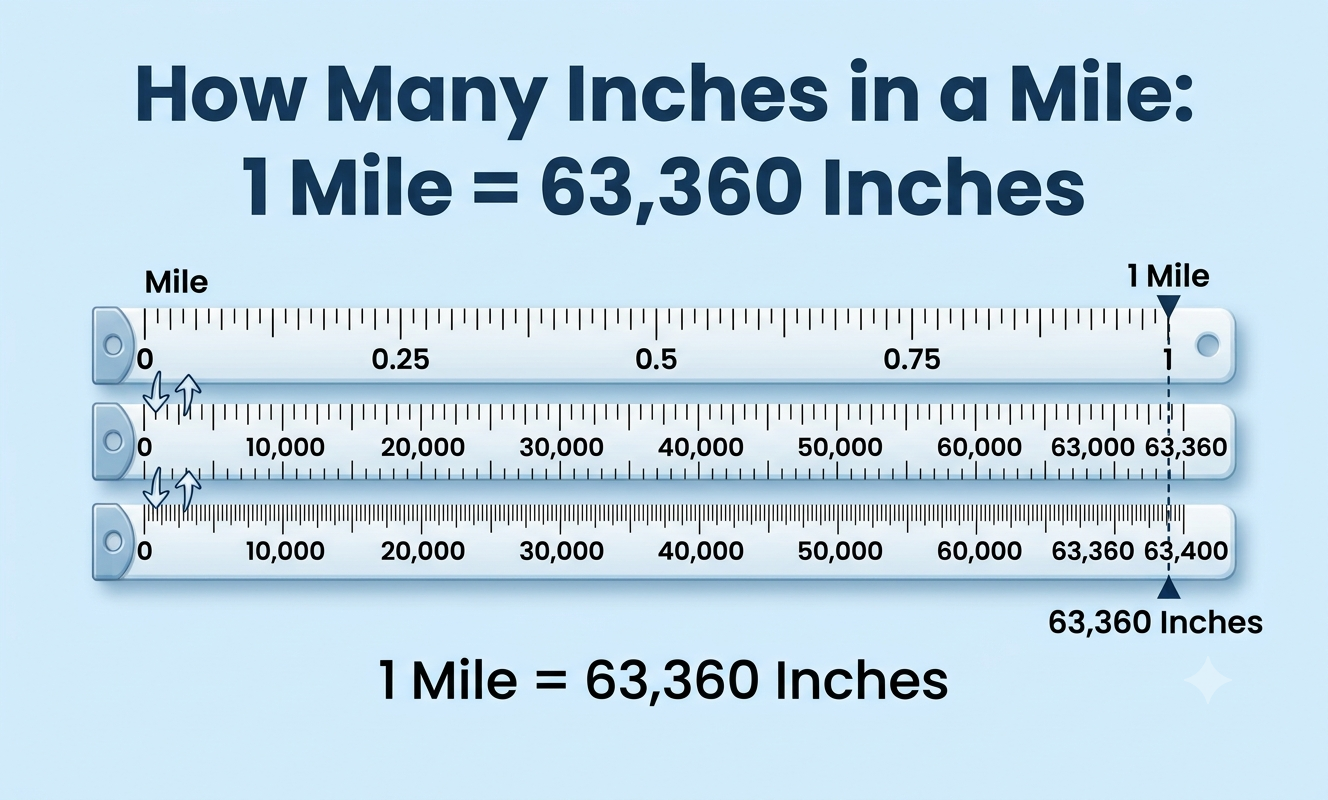
1 Mile = 63,360 Inches
- Decimal: 63,360.00 inches
- Fraction: 63,360/1 (whole number — no fraction needed)
- In feet + inches: 5,280 feet = 63,360 inches
- Formula: 1 mile × 5,280 (feet/mile) × 12 (inches/foot) = 63,360 inches
What is “How Many Inches in a Mile”?
There are exactly 63,360 inches in 1 mile. This conversion involves two units from the imperial (US customary) measurement system — miles and inches. Miles measure long distances, while inches measure short lengths. Americans, Britons, and anyone using imperial units may need this conversion for road measurements, construction projects, school math problems, or sports field calculations. It’s one of those facts that sounds surprising until you work through the math — and once you do, it sticks.
How to Convert Miles to Inches
Converting miles to inches is a two-step process because there’s no single direct multiplier taught in everyday life — but the logic is straightforward.
- The Formula
Miles × 5,280 × 12 = Inches
Or simplified: Miles × 63,360 = Inches
Step-by-Step for 1 Mile
- Start with 1 mile
- Multiply by 5,280 (the number of feet in a mile): 1 × 5,280 = 5,280 feet
- Multiply by 12 (the number of inches in a foot): 5,280 × 12 = 63,360 inches
- Reverse: Inches to Miles
Inches ÷ 63,360 = Miles
Example: 126,720 inches ÷ 63,360 = 2 miles
Both methods are valid. Use multiplication when going miles → inches, and division when going inches → miles.
Real-World Examples: What Does 63,360 Inches Look Like?
It’s hard to picture 63,360 inches in the abstract. Here are some ways to make it concrete.
A standard running track A standard outdoor running track is 400 meters, roughly 0.25 miles or about 15,840 inches in circumference. You’d need to lap the track 4 times to cover 1 mile — and all 63,360 inches of it.
Football fields lined up end to end An American football field (including end zones) is 120 yards = 4,320 inches long. You’d need to place roughly 14.67 football fields end to end to equal one mile’s worth of inches.
A city block In a typical US city, one block is about 264 feet = 3,168 inches. One mile contains approximately 20 city blocks, which gives you 20 × 3,168 = 63,360 inches — checks out perfectly.
Stacked dollar bills A US dollar bill is 6.14 inches long. Laid end to end, it would take about 10,320 dollar bills to stretch one mile. That’s over $10,000 worth of ones — just to mark a single mile.
Human height comparisons The average adult is about 66–70 inches tall (5’6″–5’10”). A mile is equivalent to stacking roughly 905 to 960 average people head to toe. That’s nearly 1,000 people tall!
A school hallway A typical school hallway is about 100 feet = 1,200 inches long. One mile equals walking that hallway 52.8 times — almost 53 laps.
Practical Use Cases
- DIY & Home Improvement
When planning fencing, irrigation lines, or road frontage on large rural properties, measurements can quickly jump from feet into miles. Knowing that 1 mile = 63,360 inches helps contractors and homeowners cross-check supplier specs (often listed in inches or feet) against property survey distances listed in miles or fractions of miles. For example, a quarter-mile fence run is 15,840 inches of fencing material to account for.
- Fashion & Clothing / Shopping
This conversion rarely comes up in everyday clothing shopping — but it matters in textile manufacturing and fabric sourcing. Fabric is sometimes measured in yards or meters per bolt, and mills track production in miles of fabric per day. If a factory produces 2 miles of denim per day, that’s 126,720 inches — a figure that helps purchasing managers calculate cost-per-inch for budgeting.
- School, Science & Math
In middle and high school math, unit conversion problems often chain multiple steps together — exactly like the miles-to-inches conversion. Teachers use this problem to teach the unit factor method (also called dimensional analysis). A classic problem: “How many inches does light travel in one second if it moves at 186,282 miles per second?” Step one is converting miles to inches: 186,282 × 63,360 = over 11.8 billion inches per second.
Nearby Conversions Table
| Miles | Inches (Decimal) | Fraction Equivalent | In Feet |
|---|---|---|---|
| 0.50 | 31,680.00 | 31,680/1 | 2,640 ft |
| 0.60 | 38,016.00 | 38,016/1 | 3,168 ft |
| 0.70 | 44,352.00 | 44,352/1 | 3,696 ft |
| 0.80 | 50,688.00 | 50,688/1 | 4,224 ft |
| 0.90 | 57,024.00 | 57,024/1 | 4,752 ft |
| 1.00 | 63,360.00 | 63,360/1 | 5,280 ft |
| 1.25 | 79,200.00 | 79,200/1 | 6,600 ft |
| 1.50 | 95,040.00 | 95,040/1 | 7,920 ft |
| 1.75 | 110,880.00 | 110,880/1 | 9,240 ft |
| 2.00 | 126,720.00 | 126,720/1 | 10,560 ft |
| 2.50 | 158,400.00 | 158,400/1 | 13,200 ft |
Frequently Asked Questions
Q: How many inches are in a mile? A: There are exactly 63,360 inches in 1 mile. This is calculated by multiplying 5,280 feet (per mile) by 12 inches (per foot), giving 5,280 × 12 = 63,360.
Q: Is the number of inches in a mile a whole number? A: Yes — 63,360 is a whole number with no remainder or fraction. Both 5,280 and 12 are whole numbers, so their product is always exact. No rounding is needed for this conversion.
Q: How many feet are in a mile, and how does that relate to inches? A: There are 5,280 feet in a mile. Since each foot contains 12 inches, you multiply 5,280 × 12 to get 63,360 inches. Feet are the intermediate unit that bridges miles and inches.
Q: How do I convert inches back to miles? A: Divide the number of inches by 63,360 to get miles. For example, 190,080 inches ÷ 63,360 = 3 miles. You can also divide by 5,280 first to get feet, then divide by 5,280 again — but the single-step division is faster.
Q: Is a mile longer than 60,000 inches? A: Yes — a mile is 63,360 inches, which is 3,360 inches longer than 60,000 inches. 60,000 inches equals about 0.947 miles, just slightly less than a full mile.
Q: What common distances are close to a mile in inches? A: A standard running track lap (400 meters) is about 15,840 inches, so 4 laps ≈ 1 mile. An American football field is 4,320 inches (120 yards), and about 14.67 fields end to end equals one mile. These are the easiest real-world mental benchmarks.
Tips for Converting Miles to Inches
1. Use the two-step method to avoid errors Don’t try to memorize 63,360 directly. Instead, recall that 1 mile = 5,280 feet, then multiply by 12 inches per foot. Two smaller numbers are easier to work with than one large one.
2. Use the shortcut for half and quarter miles Half a mile = 63,360 ÷ 2 = 31,680 inches. A quarter mile = 63,360 ÷ 4 = 15,840 inches. These pop up often in running and real estate, so they’re worth memorizing.
3. Avoid the most common mistake: skipping the ×12 step Many people convert miles to feet (×5,280) and forget to then convert feet to inches (×12). Always ask yourself: “Am I at feet or inches?” before writing your final answer.
4. Decimals are always fine here — no fractions needed Because 63,360 is a whole number, all mile-to-inch conversions for whole or common decimal miles (0.25, 0.5, 0.75, 1.0, etc.) produce clean whole numbers. No messy fractions required.
5. Use an online calculator to double-check For large or unusual values (e.g., 3.78 miles to inches), use a unit conversion calculator to verify your math. Tools like Google’s built-in converter (type “3.78 miles to inches” in the search bar) give instant results and reduce arithmetic errors.
Related Conversions
- 2 miles to inches — 126,720 inches
- 5 miles to inches — 316,800 inches
- 10 miles to inches — 633,600 inches
- 0.5 miles to inches — 31,680 inches
- 0.25 miles to inches — 15,840 inches
- Inches to miles — divide inches by 63,360
- Miles to feet — multiply miles by 5,280
- Miles to yards — multiply miles by 1,760
- Miles to kilometers — multiply miles by 1.60934
- Feet to inches — multiply feet by 12
- Yards to inches — multiply yards by 36
- Kilometers to inches — multiply km by 39,370.1
Conclusion
There are exactly 63,360 inches in 1 mile — a precise, whole-number conversion you can calculate anytime by multiplying 5,280 feet by 12 inches. Whether you’re solving a school problem, planning a construction project, or just satisfying your curiosity, this is one conversion worth knowing by heart. Bookmark this page for quick reference the next time miles-to-inches comes up!