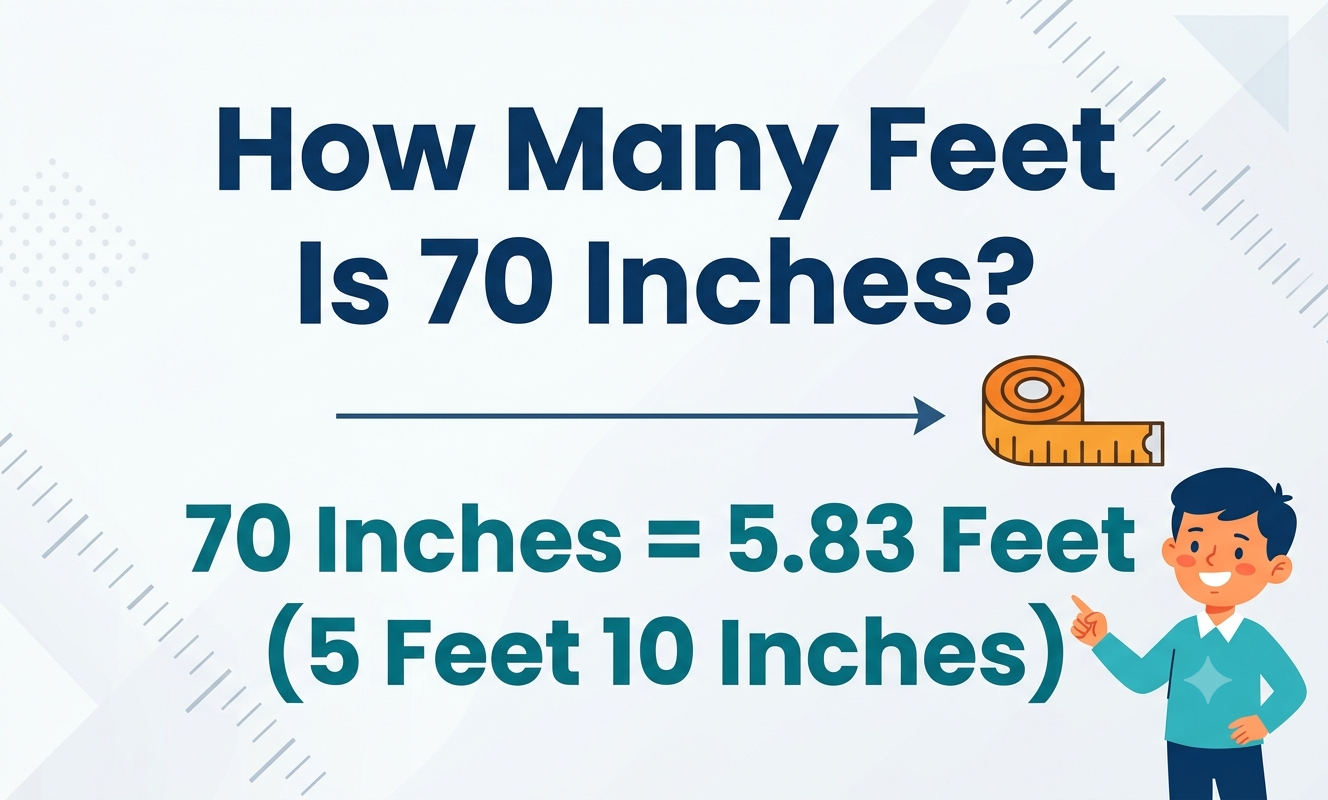
introduction to How Many Feet Is 70 Inches
Quick Answer Box
70 Inches = 5.83 Feet
- Decimal format: 70 inches = 5.833 feet
- Fraction format: 70 inches = 5 5/6 feet
- Feet + inches format: 70 inches = 5 feet 10 inches
- Formula used: 70 ÷ 12 = 5.83 feet
What is 70 Inches in Feet?
70 inches equals 5.83 feet, or more precisely, 5 feet and 10 inches. This conversion moves a measurement within the imperial system, since both inches and feet belong to the same US and UK measuring standard — no metric units are involved here. People convert inches to feet most often when measuring height, checking furniture or door dimensions, reading building blueprints, or comparing shipping box sizes. Because the US still uses inches and feet daily (unlike most of the world, which uses centimeters and meters), this conversion is a common everyday task for students, shoppers, and DIY homeowners alike.
How to Convert Inches to Feet
Converting inches to feet uses one simple rule: there are 12 inches in 1 foot.
Formula (divide): Inches ÷ 12 = Feet
Step-by-step for 70 inches:
- Take the total inches: 70
- Divide by 12: 70 ÷ 12 = 5.8333…
- Round to two decimals: 5.83 feet
- To get feet and inches: 5 whole feet = 60 inches (5 × 12). Subtract: 70 − 60 = 10 inches left over
- Final answer: 5 feet 10 inches
Reverse formula (multiply): Feet × 12 = Inches Check: 5.833 × 12 = 70 inches ✔️
Both methods confirm the same result, so you can use whichever feels easier — multiplying to double-check your work is always a smart habit.
Real-World Examples: What Does 70 Inches Look Like?
- A tall adult’s height. 70 inches (5’10”) is a common adult male height in the US — roughly average to slightly above average.
- A doorway. Standard interior doors are about 80 inches tall, so 70 inches would sit noticeably below the top of a typical door frame.
- A large TV, laid flat. A 75-inch television is close in length to 70 inches, giving you a sense of scale for a big-screen setup.
- A twin bed’s short side. Some compact twin mattresses run close to 70 inches — useful when checking if a bed fits a small room.
- A tall bookshelf. Many freestanding bookshelves stand around 70 inches, just under 6 feet, making them tall enough for storage without touching the ceiling.
- A surfboard. Longboards often measure close to 70 inches, giving surfers a quick visual reference for board length.
Practical Use Cases
DIY & Home Improvement
When installing shelving, curtains, or cabinets, contractors often work in feet and inches together. If a wall space measures 70 inches, you’d tell a hardware store clerk or contractor it needs 5 feet 10 inches of material — this avoids confusion when ordering lumber, trim, or fabric that’s typically sold by the foot.
Fashion & Clothing / Shopping
Height charts for clothing, especially for tall-sizing brands, often list 70 inches as a cutoff point for “tall” fits. Knowing that 70 inches = 5’10” helps shoppers quickly find pants, dresses, or coats sized for their exact height without doing mental math at checkout.
School, Science & Math
Students learning the imperial measurement system practice converting inches to feet as an early lesson in unit conversion. A typical homework problem — “convert 70 inches to feet” — teaches the divide-by-12 rule, which later applies to real-world skills like reading tape measures and rulers accurately.
Nearby Conversions Table
| Inches | Feet (Decimal) | Fraction | Feet + Inches |
|---|---|---|---|
| 65 in | 5.42 ft | 5 5/12 ft | 5 ft 5 in |
| 66 in | 5.50 ft | 5 1/2 ft | 5 ft 6 in |
| 67 in | 5.58 ft | 5 7/12 ft | 5 ft 7 in |
| 68 in | 5.67 ft | 5 2/3 ft | 5 ft 8 in |
| 69 in | 5.75 ft | 5 3/4 ft | 5 ft 9 in |
| 70 in | 5.83 ft | 5 5/6 ft | 5 ft 10 in |
| 71 in | 5.92 ft | 5 11/12 ft | 5 ft 11 in |
| 72 in | 6.00 ft | 6 ft | 6 ft 0 in |
| 73 in | 6.08 ft | 6 1/12 ft | 6 ft 1 in |
| 74 in | 6.17 ft | 6 1/6 ft | 6 ft 2 in |
| 75 in | 6.25 ft | 6 1/4 ft | 6 ft 3 in |
Frequently Asked Questions
Q: How many feet is 70 inches? A: 70 inches equals 5.83 feet, or exactly 5 feet 10 inches. You get this by dividing 70 by 12, since there are 12 inches in every foot.
Q: What is 70 inches as a fraction of a foot? A: 70 inches equals 5 5/6 feet as a fraction. The 10 leftover inches become 10/12, which simplifies down to 5/6.
Q: How do I convert 70 inches to feet and inches together? A: Divide 70 by 12 to get 5 whole feet (60 inches), then subtract: 70 − 60 = 10 inches remaining. So the answer is 5 feet 10 inches.
Q: How many centimeters is 70 inches? A: 70 inches equals 177.8 centimeters. You get this by multiplying inches by 2.54 (70 × 2.54 = 177.8 cm).
Q: Is 70 inches taller than 5 feet 9 inches? A: Yes. 5 feet 9 inches equals 69 inches, which is 1 inch shorter than 70 inches (5’10”). So 70 inches is slightly taller.
Q: What common object is about 70 inches long or tall? A: A tall adult (5’10”), a large 75-inch TV laid on its side, or a tall bookshelf are all close to 70 inches, giving you an easy real-world reference point.
Tips for Converting Inches to Feet
- Quick mental math trick: Since 12 × 6 = 72, you know 70 inches must be just under 6 feet — a fast way to estimate before doing the exact division.
- Use decimals for measuring tools and math class, but switch to feet + inches format when talking to contractors, tailors, or anyone using a tape measure — it’s the more natural spoken format.
- Common mistake to avoid: Don’t confuse “5.83 feet” with “5 feet 8 inches.” The .83 is a decimal fraction of a foot, not inches — always multiply the decimal part by 12 to get the correct leftover inches (0.83 × 12 ≈ 10).
- Double-check your work by converting back: multiply your feet answer by 12 and confirm it equals your original inch value.
- Use an online inches-to-feet calculator for instant, error-free results, especially when converting odd or repeating decimals like 70 ÷ 12.
Conclusion
To sum up, 70 inches equals 5.83 feet, or exactly 5 feet 10 inches — a simple result of dividing by 12. Whether you’re measuring height, furniture, or wall space, this conversion is one you’ll use often, so bookmark this page or share it for quick reference next time you need it.