Quick Answer Box
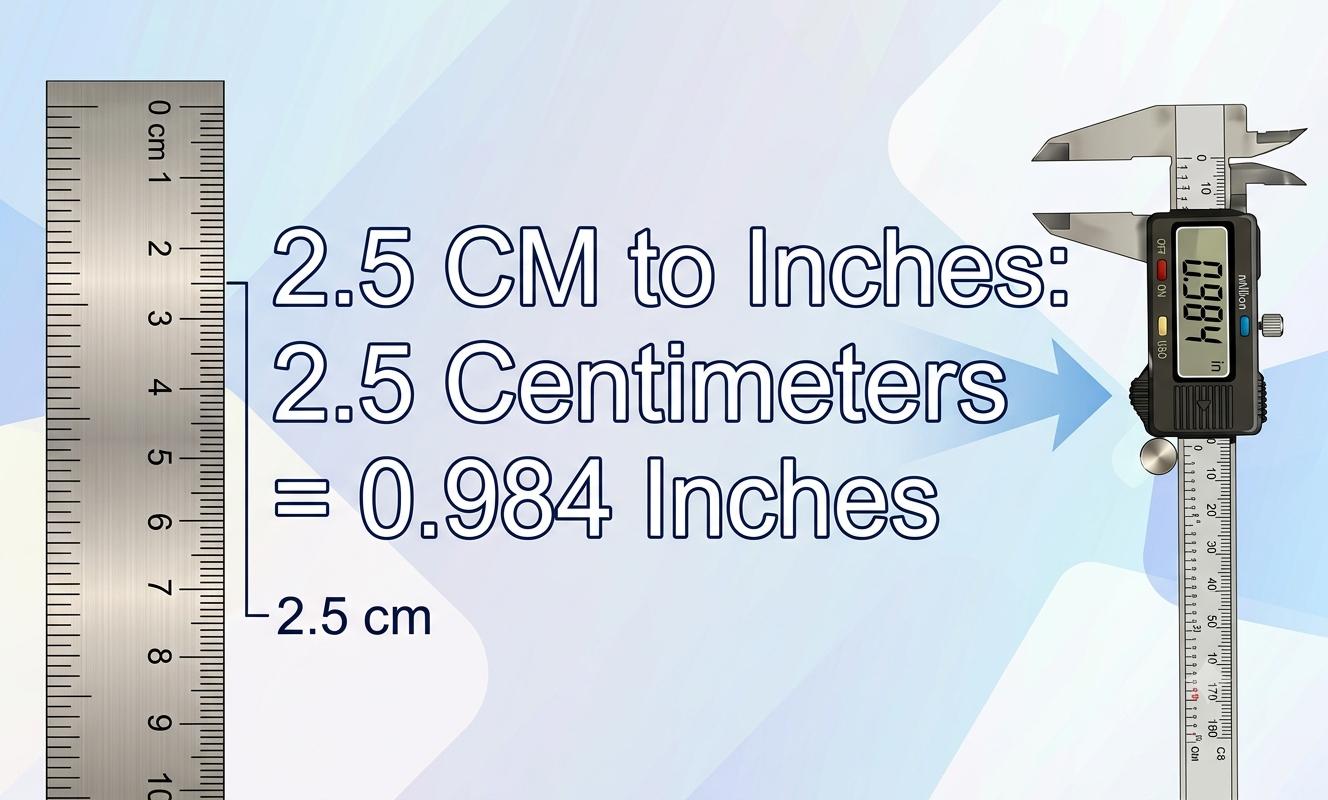
2.5 Centimeters = 0.984 Inches
- Decimal: 0.984 inches
- Fraction: approximately 63/64 inches (≈ 1 inch)
- Feet + Inches: 0 feet 0.984 inches
- Formula: 2.5 ÷ 2.54 = 0.984 inches
What is 2.5 CM to Inches?
2.5 centimeters equals 0.984 inches, which is just barely under 1 full inch. Centimeters belong to the metric system, used across most of the world. Inches belong to the imperial system, used mainly in the United States, UK (partially), and Canada. This conversion comes up often in online shopping (especially for jewelry, screen sizes, and shoe widths), school homework, crafting, and DIY projects. Knowing that 2.5 cm ≈ 1 inch is one of the most useful quick-reference facts in unit conversion.
How to Convert 2.5 CM to Inches
The conversion factor between centimeters and inches is 1 inch = 2.54 cm.
Method 1 — Divide by 2.54 (most accurate)
2.5 ÷ 2.54 = 0.9843 inches
Method 2 — Multiply by 0.3937
2.5 × 0.3937 = 0.9843 inches
Both methods give the same result. For most everyday purposes, you can simply round 0.984 to 1 inch — the error is less than 2%. If you need precision (for engineering or science), always use the full decimal 0.9843 inches.
Step-by-step for Method 1:
- Take your value: 2.5
- Divide by the conversion factor: 2.5 ÷ 2.54
- Result: 0.9843 inches
Real-World Examples: What Does 2.5 CM Look Like?
2.5 cm is almost exactly 1 inch. Here are relatable objects to picture this measurement:
A Standard Bottle Cap The cap on a regular plastic water bottle or soda bottle is approximately 2.5 cm (1 inch) in diameter. Next time you hold one, you’re looking at exactly this measurement.
A Large Grape or Marble A full-sized grape or a standard glass marble measures roughly 2–2.5 cm across. It’s a small but solid, tangible size you can feel in your hand.
The Width of a USB Port A standard USB-A port opening is about 1.4 cm wide and 0.6 cm tall, but the outer casing of a USB port plug (including the housing) spans close to 2.5 cm in length — very handy for tech comparisons.
A Thick Stack of Credit Cards Stack 7 standard credit cards on top of each other. That stack is approximately 2.5 cm tall. This is a great mental image for thickness measurements.
A Large Eraser (School Rubber) The small rectangular erasers used in school pencil boxes are often 2.5–3 cm long. Next time you’re at your desk, grab one and you’re holding roughly 1 inch in your hand.
A Baby’s Fingernail A baby’s fingernail or a small shirt button is typically around 2.5 cm in diameter — a sweet reminder of how tiny yet specific this measurement is.
Practical Use Cases
DIY & Home Improvement
When you’re working on home projects, 2.5 cm shows up constantly. Grout lines between tiles are sometimes set at 2–3 mm, but small wood screws, drill bits, and dowel rods are often listed in centimeters. If your plan calls for a 2.5 cm gap or trim piece, you know that’s just under 1 inch — which maps directly to standard imperial measurements found at hardware stores in the US. Always double-check your conversion before cutting!
Fashion & Clothing / Shopping
Online fashion sizing — especially from Asian marketplaces like AliExpress, Meesho, or Myntra — often lists measurements in centimeters. A heel height of 2.5 cm means a very low, almost flat heel (roughly 1 inch). Similarly, jewelry ring widths, bangle thicknesses, and bracelet widths are frequently listed in centimeters. Knowing 2.5 cm = ~1 inch helps you visualize exactly what you’re buying before it arrives.
School, Science & Math
In Indian school syllabuses (CBSE, ICSE), students frequently convert between the metric and imperial systems. 2.5 cm to inches is a common exam-level problem because the answer — 0.984 inches — demonstrates the relationship between 2.54 and real-world measurement. Students learning ruler skills also find that 2.5 cm sits perfectly halfway between the 2 cm and 3 cm marks, making it a clean teaching point.
Nearby Conversions Table
| Centimeters (cm) | Inches (decimal) | Inches (fraction) | Feet + Inches |
|---|---|---|---|
| 0.5 cm | 0.197 in | 3/16 in | 0′ 0.197″ |
| 1.0 cm | 0.394 in | 25/64 in | 0′ 0.394″ |
| 1.5 cm | 0.591 in | 19/32 in | 0′ 0.591″ |
| 2.0 cm | 0.787 in | 63/80 in | 0′ 0.787″ |
| 2.3 cm | 0.906 in | 29/32 in | 0′ 0.906″ |
| 2.5 cm | 0.984 in | ≈ 63/64 in | 0′ 0.984″ |
| 2.7 cm | 1.063 in | 1 1/16 in | 0′ 1.063″ |
| 3.0 cm | 1.181 in | 1 3/16 in | 0′ 1.181″ |
| 3.5 cm | 1.378 in | 1 3/8 in | 0′ 1.378″ |
| 4.0 cm | 1.575 in | 1 37/64 in | 0′ 1.575″ |
| 4.5 cm | 1.772 in | 1 49/64 in | 0′ 1.772″ |
Frequently Asked Questions
Q: How many inches is 2.5 cm? A: 2.5 cm = 0.984 inches, which is approximately 1 inch. To get the exact value, divide 2.5 by 2.54. The result is 0.9843 inches, often rounded to 0.98 inches for everyday use.
Q: What is 2.5 cm in inches as a fraction? A: 2.5 cm in fraction form is approximately 63/64 of an inch, which is very close to a full inch. In practical terms, most people simply treat 2.5 cm as 1 inch since the difference is less than 2%.
Q: What is 2.5 cm in feet and inches? A: 2.5 cm equals 0 feet and 0.984 inches — essentially less than 1 inch, so it doesn’t reach 1 foot at all. It is purely a sub-inch measurement when expressed in the imperial foot-inch system.
Q: How many cm is 1 inch? A: 1 inch = 2.54 centimeters exactly. This is the official, internationally agreed conversion factor. So if you reverse the 2.5 cm conversion, 1 inch is slightly more than 2.5 cm (it’s 2.54 cm).
Q: Is 2.5 cm more than 1 inch? A: No — 2.5 cm is slightly less than 1 inch. Since 1 inch = 2.54 cm, you need 2.54 centimeters to make exactly one inch. At 2.5 cm, you’re 0.04 cm short of a full inch, making it 0.984 inches.
Q: What common object is 2.5 cm long? A: A standard bottle cap, a large marble, or a school rubber eraser are all approximately 2.5 cm in size. It’s also roughly the width of your thumb from the tip to the first joint — a handy body-measurement trick to remember.
Tips for Converting CM to Inches
1. Use the “Divide by 2.54” Rule The most accurate method is always: cm ÷ 2.54 = inches. Memorize 2.54 and you can convert any centimeter value to inches without a calculator.
2. Quick Mental Math: CM × 0.4 ≈ Inches For fast estimates, multiply centimeters by 0.4. For 2.5 cm: 2.5 × 0.4 = 1.0 inch — close enough for everyday use! The true answer is 0.984, so this trick gives a result just slightly above the exact value.
3. Know When to Round Use 0.984 inches for precise work (engineering, science, crafting). Use ≈ 1 inch for casual conversations, shopping, or estimates. Knowing when each is appropriate saves confusion.
4. Avoid the #1 Common Mistake Don’t confuse 2.5 cm with 2.5 mm. Millimeters are 10× smaller — 2.5 mm is only about 0.098 inches, which is barely the width of a pencil line. Always check whether your measurement is in cm or mm before converting.
5. Use an Online Calculator for Bulk Conversions If you need to convert multiple values at once (like a size chart), use a reliable online unit converter. Tools like Google’s built-in converter (just search “2.5 cm to inches” in Google) or UnitConverters.net give instant, accurate results.
Conclusion
2.5 cm = 0.984 inches — an answer worth remembering because it’s nearly identical to 1 inch, making it one of the most practical benchmarks in everyday measurement. Whether you’re shopping online, doing homework, or measuring for a DIY project, this conversion will come up again and again. Bookmark this page for quick reference, and share it with anyone who works with both metric and imperial measurements!