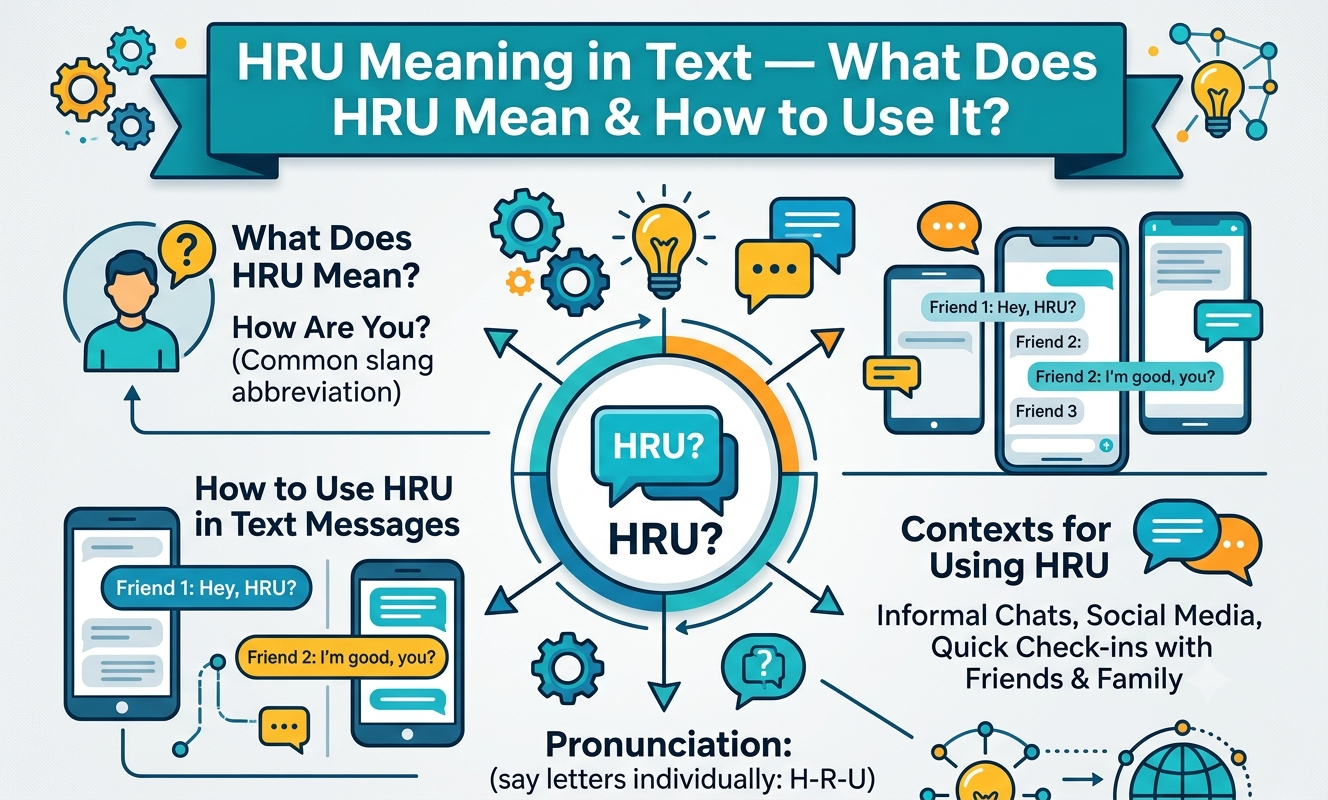
Quick Answer: HRU stands for “How Are You”. It’s a casual texting abbreviation people use to check in on someone or start a conversation, most often seen in WhatsApp chats, Snapchat streaks, TikTok comments, and group texts.
Introduction
You’re scrolling through a text thread and someone drops a simple “hru?” — no punctuation, no capital letters, just three lowercase letters waiting for a reply. If you’ve ever paused to wonder what it means, you’re not alone.
The hru meaning in text is straightforward: it’s shorthand for “How Are You.” It’s one of the most common texting abbreviations out there, used by teens, young adults, and increasingly by parents trying to keep up with digital conversations.
In this guide, you’ll learn where HRU came from, how to use it correctly, what it looks like on different apps in 2026, whether it can come across as rude, and how to reply when someone sends it to you. By the end, you’ll be able to use HRU (and understand it) like a pro.
What Does HRU Mean?
HRU is a texting abbreviation for “How Are You.” It’s used as a quick, informal way to check in with someone, usually at the start or middle of a conversation.
Abbreviations like HRU became popular in the early 2000s alongside the rise of SMS texting, when character limits and slow typing on flip phones pushed people to shorten common phrases. As smartphones, group chats, and messaging apps took over, these shortcuts stuck around because they’re fast and effortless to type.
By 2026, HRU has become even more common thanks to voice-to-text habits, quick-reply keyboard suggestions, and the constant back-and-forth nature of Snapchat and Instagram DMs. Younger users especially treat it as a default greeting, similar to how older generations might type “how’s it going.”
HRU is not tied to any single platform. You’ll see it in:
- One-on-one texts between friends
- Group chats
- Comment sections
- Direct messages on social apps
- Even some casual work Slack messages among younger colleagues
HRU Full Form Explained
HRU is an acronym, meaning each letter stands for the first letter of a word in the phrase it represents.
| Letter | Stands For |
|---|---|
| H | How |
| R | aRe |
| U | yoU |
Full form: How aRe yoU → How Are You
Notice that the “R” and “U” don’t just stand for whole words — they’re phonetic substitutes. “R” sounds like “are,” and “U” sounds like “you.” This letter-for-sound trick is common in texting slang, seen in similar abbreviations like CU (see you) or RU (are you).
How to Use HRU — Real Examples
HRU can be used in many emotional contexts, from casual check-ins to genuine concern. Here are examples showing its range:
| Situation | Example | Emotion |
|---|---|---|
| Starting a casual chat | “Hey, hru? Haven’t talked in a while” | Friendly |
| Checking on a sick friend | “Saw you missed school today, hru?” | Concerned |
| After a breakup | “I know things are tough rn, hru holding up?” | Supportive |
| Morning greeting | “Morning! hru today?” | Warm |
| Following up on bad news | “That sucks about the exam, hru feeling now?” | Empathetic |
| Reconnecting with an old friend | “It’s been forever! hru?? What’s new” | Excited |
| During a work break (casual teams) | “Long meeting lol, hru holding up” | Light-hearted |
| After sharing exciting news | “OMG congrats!! hru celebrating tonight?” | Happy |
| Late-night check-in | “Can’t sleep, hru?” | Reflective |
| After an argument | “Hey, I don’t want to fight. hru feeling now?” | Reconciliatory |
As these examples show, HRU isn’t just a greeting — it can carry real emotional weight depending on the context and tone of the conversation.
HRU on Different Platforms (2026)
How HRU shows up depends heavily on the app being used. Here’s how it typically appears across the most popular platforms in 2026.
On WhatsApp
WhatsApp remains one of the most widely used messaging apps globally, and HRU is common in both one-on-one and group chats. Because WhatsApp supports longer, more detailed conversations, HRU is often followed by a genuine question, like “hru, everything good at home?”
On Snapchat
On Snapchat, HRU frequently appears in caption text on snaps or within chat streaks. Since Snapchat conversations are fast-paced and disappear quickly, HRU is used as a low-effort way to keep a streak or conversation going without much thought.
On TikTok
On TikTok, HRU shows up mostly in comment sections and DMs rather than video captions. It’s often used casually between creators and followers, or in comment threads where users check in on each other during trending or emotional videos.
On Instagram
Instagram DMs and comments see heavy HRU usage, especially among younger users replying to Stories. A friend might reply to your Story with just “hru?” as an easy way to open a private conversation.
Across all these platforms, the core meaning stays the same — HRU is simply a fast, informal way to ask someone how they’re doing, adapted to fit each app’s pace and style.
Is HRU Rude or Offensive?
HRU itself is not offensive — it’s simply a shortened way of asking a normal, friendly question. However, context matters.
Why it might come across as low-effort:
- Sending “hru” with no other context, especially after a long gap in conversation, can feel impersonal to some people.
- In formal settings (like emails to teachers or professional messages), HRU can seem unprofessional or too casual.
Why it’s usually fine:
- Among friends and peers, it’s a completely normal, widely accepted way to check in.
- It often reflects familiarity and comfort rather than disrespect.
- Many people use it precisely because it’s easy and non-intrusive, not because they don’t care.
The bottom line: HRU is appropriate in casual, friendly conversations but should generally be avoided in formal or professional writing, where “How are you?” written out in full is a safer choice.
How to Reply to HRU
Replying to HRU doesn’t need to be complicated, but your response can set the tone for the rest of the conversation.
| Reply Type | Example Response | When to Use |
|---|---|---|
| Simple positive | “Good, hbu?” | Everyday casual chat |
| Honest and detailed | “Been a rough week tbh, you?” | When you want to open up |
| Short and neutral | “I’m okay, u?” | Quick check-ins |
| Enthusiastic | “Great actually! Just got good news” | Sharing good vibes |
| Redirecting | “Doing fine, more importantly hru?” | Showing you care back |
| Non-committal | “Meh, same old” | Low-energy days |
A good rule of thumb: match the energy of the person who texted you. If they seem genuinely concerned, a short “fine” might feel dismissive — a slightly longer reply keeps the conversation warm.
HRU Alternatives and Similar Slang
HRU isn’t the only shorthand way to ask how someone’s doing. Here are other common texting abbreviations with similar meanings.
| Abbreviation | Meaning |
|---|---|
| HBU | How About You |
| WYD | What You Doing |
| SUP | What’s Up |
| HW | How’s it going |
| YOK | You OK? |
| RU OK | Are You OK |
| WBU | What About You |
| HYD | How You Doing |
These terms are often used interchangeably or combined in the same conversation — for example, “hru, wyd rn?” is a common combo asking both how someone is and what they’re currently doing.
Frequently Asked Questions (FAQ)
Q: What does HRU mean in text? A: HRU means “How Are You.” It’s a casual texting abbreviation used to check in on someone or start a conversation.
Q: Is HRU the same as HBU? A: No. HRU means “How Are You,” while HBU means “How About You” — HBU is usually used as a follow-up question after someone shares how they’re doing.
Q: Is HRU only used by teens? A: While HRU is most common among teens and young adults, it’s used across age groups in casual texting, especially by anyone active on messaging apps and social media.
Q: How do you reply to HRU in a text? A: You can reply simply with “Good, hbu?” or give a more detailed answer depending on how close you are to the person and how the conversation is going.
Q: Is it okay to use HRU in a formal message? A: It’s best to avoid HRU in formal or professional messages. Writing out “How are you?” in full is more appropriate for emails, work chats, or messages to teachers.
Q: What’s the difference between HRU and RU OK? A: HRU is a general greeting asking how someone is doing, while “RU OK” (Are You OK) is more specifically used when checking on someone’s wellbeing, often after noticing something seems wrong.
Conclusion
HRU is a small but useful piece of texting shorthand that simply means “How Are You.” Whether you’re chatting on WhatsApp, replying to a Snapchat streak, or commenting on a TikTok video, HRU works as a quick, friendly way to check in with someone.
Understanding the hru meaning in text, when to use it, and how to reply can help you navigate casual conversations more naturally — whether you’re texting a friend, catching up with family, or just trying to keep up with how younger generations communicate.
Also read 78 Inches to Feet: 78 Inches = 6.5 Feet