Quick Answer Box
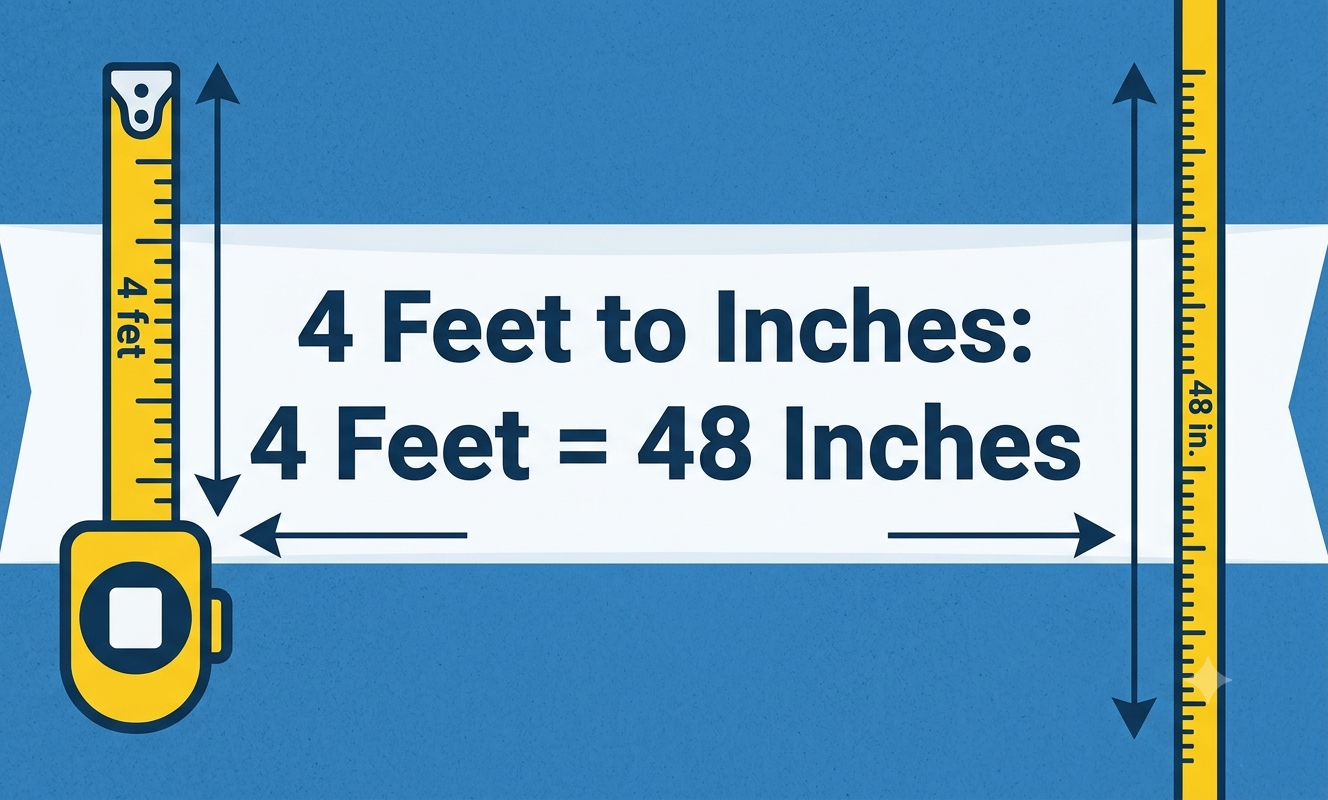
🔑 4 Feet = 48 Inches
- Decimal format: 4 ft = 48.0 inches
- Fraction format: 48 inches (no fraction needed — it’s a whole number)
- Feet + inches format: 4 feet 0 inches
- Formula used: 4 (feet) × 12 (inches per foot) = 48 inches
What is 4 Feet to Inches?
4 feet equals 48 inches. This is a common conversion between the imperial (US/UK) measurement system, where both feet and inches are used to measure height, length, and distance. Since one foot always equals 12 inches, converting feet to inches is one of the simplest calculations in the imperial system.
People convert 4 feet to inches for many reasons: parents tracking a child’s height, shoppers checking furniture or curtain dimensions, students solving math homework, and DIYers measuring lumber, shelving, or wall space. Knowing that 4 feet = 48 inches helps you quickly compare measurements listed in different units.
How to Convert Feet to Inches
The formula for converting feet to inches is simple:
Feet × 12 = Inches
Step-by-step for 4 feet:
- Start with the value in feet: 4
- Multiply by the conversion factor: 4 × 12 = 48
- Result: 4 feet = 48 inches
The reverse method (inches to feet):
If you already have inches and want feet, divide by 12: 48 ÷ 12 = 4 feet
Both methods confirm the same relationship. Multiplying is the go-to method when you have feet and need inches (like turning 4 feet into 48 inches), while dividing works when you’re going the other direction. Since 12 is an easy number to multiply, you can do this conversion in your head — no calculator required for most feet-to-inches problems.
Real-World Examples: What Does 4 Feet (48 Inches) Look Like?
- A kitchen countertop height: Standard countertops are close to 48 inches off the floor when you include upper cabinets — a helpful visual for kitchen remodeling.
- A young child’s height: Many kids reach 4 feet (48 inches) tall around ages 8-9, making this a common milestone parents track.
- A standard interior door width area: Many entry tables or console furniture pieces are designed around 48 inches long to fit hallways.
- A folding table: Popular rectangular folding tables (used for parties or offices) are commonly 48 inches long.
- Plywood sheets: Standard plywood and drywall sheets are 48 inches wide (4 feet), which is why “4×8 sheet” is a universal building term.
- A twin bed’s width area: While not exact, 48 inches is close to reference points people use when planning bedroom layouts.
Practical Use Cases
DIY & Home Improvement
Builders constantly work with 4-foot (48-inch) measurements because standard plywood, drywall, and paneling sheets are manufactured at this width. When you hear a contractor mention a “4×8 sheet,” they mean 48 inches by 96 inches. Knowing this conversion helps you plan stud spacing, cut lumber accurately, and order the right materials without guessing.
Fashion & Clothing / Shopping
Clothing and furniture retailers often list sizes in inches even when shoppers think in feet. If a curtain panel is listed as 48 inches long, that’s exactly 4 feet — useful for matching window height. Kids’ clothing size charts also reference height in inches, so knowing a child is 48 inches (4 feet) tall helps parents pick the right size instantly.
School, Science & Math
Students learn the feet-to-inches conversion early in measurement units because it’s foundational to understanding the imperial system. Word problems often ask students to convert 4 feet to inches to practice multiplication by 12. This conversion also appears in science classes when measuring plant growth, distances, or lab specimens using standard rulers and yardsticks.
Nearby Conversions Table
| Feet | Inches (Decimal) | Fraction | Feet Format |
|---|---|---|---|
| 1.5 ft | 18.0 in | 18 in | 1 ft 6 in |
| 2 ft | 24.0 in | 24 in | 2 ft 0 in |
| 2.5 ft | 30.0 in | 30 in | 2 ft 6 in |
| 3 ft | 36.0 in | 36 in | 3 ft 0 in |
| 3.5 ft | 42.0 in | 42 in | 3 ft 6 in |
| 4 ft | 48.0 in | 48 in | 4 ft 0 in |
| 4.5 ft | 54.0 in | 54 in | 4 ft 6 in |
| 5 ft | 60.0 in | 60 in | 5 ft 0 in |
| 5.5 ft | 66.0 in | 66 in | 5 ft 6 in |
| 6 ft | 72.0 in | 72 in | 6 ft 0 in |
| 6.5 ft | 78.0 in | 78 in | 6 ft 6 in |
Frequently Asked Questions
Q: How many inches is 4 feet? A: 4 feet equals 48 inches. You get this by multiplying 4 by 12, since there are 12 inches in every foot.
Q: Is 4 feet to inches a whole number or a fraction? A: It’s a whole number. Since 4 feet converts to exactly 48 inches, there’s no fraction or decimal remainder to worry about.
Q: How do I convert 4 feet into feet and inches format? A: 4 feet is already a whole number of feet, so it stays as 4 feet 0 inches. There’s no leftover inches because 4 divides evenly.
Q: How many centimeters is 4 feet (48 inches)? A: 4 feet equals about 121.92 centimeters. You get this by multiplying 48 inches by 2.54 cm per inch.
Q: Is 4 feet more than 50 inches? A: No. 4 feet equals 48 inches, which is 2 inches less than 50 inches. You’d need slightly more than 4 feet (4 feet 2 inches) to reach 50 inches.
Q: What common object is about 48 inches (4 feet) long? A: A standard plywood or drywall sheet is 48 inches wide, and many folding tables and countertops also measure close to 48 inches.
Tips for Converting Feet to Inches
- Mental math trick: Multiply the number of feet by 12. For whole numbers like 4, this is easy: 4 × 12 = 48.
- Use decimals for precision: When feet include a fraction (like 4.5 feet), convert to decimal first, then multiply by 12 for an exact inch value.
- Avoid the common mistake: Don’t confuse feet-to-inches (×12) with inches-to-feet (÷12) — mixing these up is the most frequent conversion error.
- Double-check with the reverse formula: After converting, divide your answer by 12 to confirm you land back on the original feet value.
- Use an online calculator for complex numbers: For measurements with fractions or decimals (like 4⅓ feet), an online length converter removes any guesswork and guarantees accuracy.
Conclusion
4 feet equals exactly 48 inches — a simple, whole-number conversion using the formula feet × 12 = inches. Whether you’re measuring furniture, tracking height, or working on a home project, this conversion is one you’ll use often, so bookmark this page or share it for quick reference anytime you need it.