Quick Answer Box
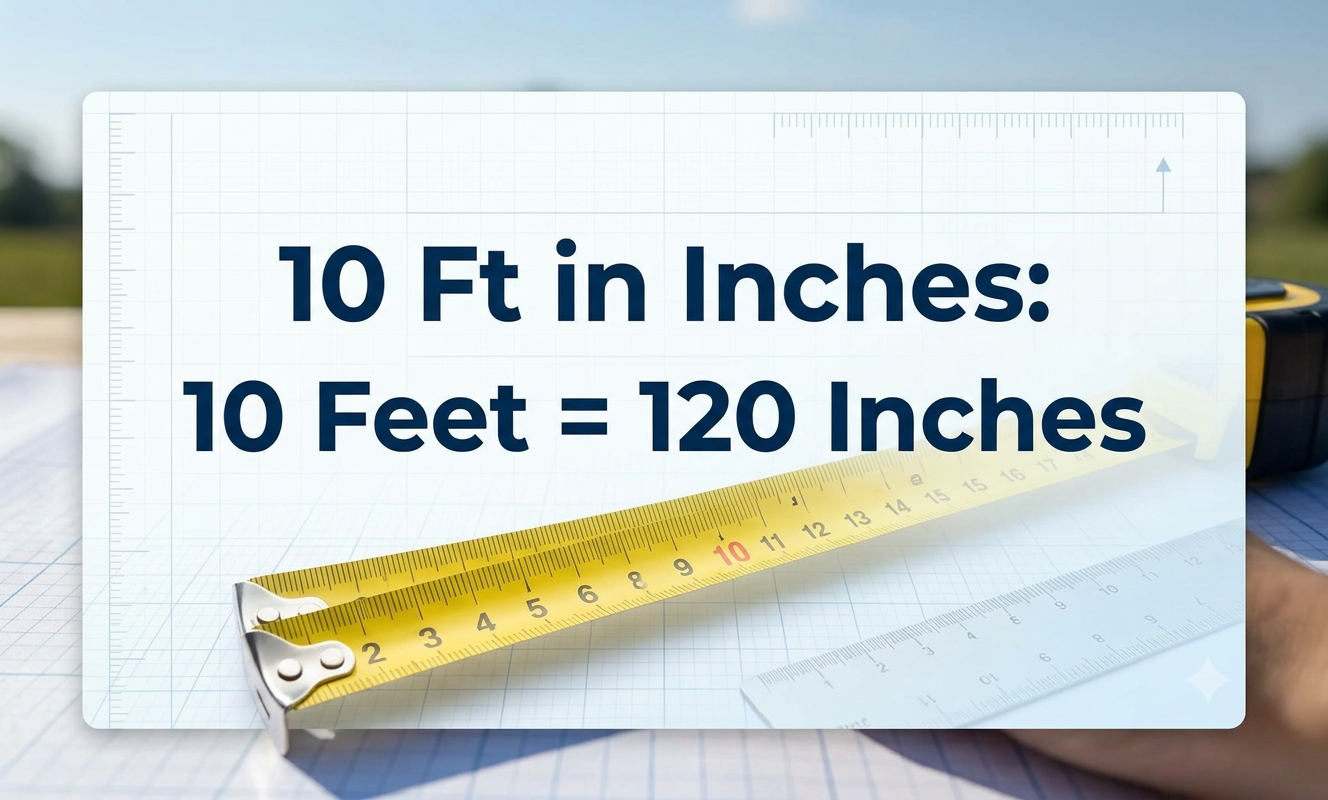
10 feet = 120 inches
- Decimal: 120.0 inches
- Fraction: 120/1 inches (a whole number, no fraction needed)
- Feet + Inches format: 10 ft 0 in
- Formula: 10 ft × 12 = 120 inches
What is 10 Ft in Inches?
10 feet equals 120 inches. This is one of the simplest conversions in the imperial measurement system because both feet and inches belong to the same system — there’s no metric-to-imperial math involved, just a straight multiplication. People use this conversion for construction projects, furniture sizing, room dimensions, fencing, curtains, and DIY plans in the US, UK, Canada, and other countries that still rely on imperial units for everyday measuring. Contractors, students, and homeowners all reach for this conversion regularly when project instructions list one unit but a tape measure shows another.
How to Convert Feet to Inches
The formula is simple: 1 foot = 12 inches. To convert any measurement in feet to inches, multiply by 12.
Step-by-step for 10 feet:
- Start with 10 feet.
- Multiply by the conversion factor: 10 × 12 = 120.
- Result: 120 inches.
Reverse method (inches to feet): divide the inch value by 12. So 120 ÷ 12 = 10 feet, confirming the answer.
There’s no rounding needed here since 10 feet converts to a clean whole number. This makes it one of the easiest feet-to-inches conversions to memorize and double-check by hand, without needing a calculator.
Real-World Examples: What Does 10 Feet (120 Inches) Look Like?
- Ceiling height: A 10-foot ceiling is common in older homes, lofts, and luxury builds — noticeably taller than the standard 8-foot ceiling.
- A single-car garage door: Many standard garage doors are close to 10 feet wide, giving enough clearance for a full-size vehicle.
- A large area rug: A 10 ft x 12 ft rug is a popular size for living rooms and dining spaces.
- A school bus width reference: The interior width of a school bus is roughly 10 feet, useful for picturing the span.
- Two adult humans lying head to toe: Since the average adult is around 5–6 feet tall, 10 feet roughly equals two people stacked head to toe.
- A small backyard shed: Many prefab storage sheds are sold in 10 ft x 10 ft footprints, a popular DIY size.
Practical Use Cases
DIY & Home Improvement
When building a deck, fence, or shed, 10 feet (120 inches) is a go-to standard length for lumber and fencing panels. Knowing that 10 ft = 120 in helps you match tape-measure readings (usually in inches) to blueprint specs (often in feet), avoiding costly cutting mistakes on lumber, drywall sheets, or PVC piping.
Fashion & Clothing / Shopping
While 10 feet is too large for clothing itself, it’s a common measurement for curtains, drapery rods, and fabric bolts. A 120-inch curtain panel stretches floor-to-ceiling in rooms with tall windows, and knowing the inch equivalent helps when ordering custom drapes online where sizes are listed in inches.
School, Science & Math
Students often convert 10 ft to 120 inches in geometry or physics problems involving area, perimeter, or unit conversion drills. It’s also a handy benchmark in science class for estimating distances — for example, describing how far a ball rolled or how tall a plant grew over a semester.
Nearby Conversions Table
| Feet | Inches (decimal) | Fraction | Feet (equivalent) |
|---|---|---|---|
| 5 ft | 60 in | 60/1 in | 5 ft |
| 6 ft | 72 in | 72/1 in | 6 ft |
| 7 ft | 84 in | 84/1 in | 7 ft |
| 8 ft | 96 in | 96/1 in | 8 ft |
| 9 ft | 108 in | 108/1 in | 9 ft |
| 10 ft | 120 in | 120/1 in | 10 ft |
| 11 ft | 132 in | 132/1 in | 11 ft |
| 12 ft | 144 in | 144/1 in | 12 ft |
| 13 ft | 156 in | 156/1 in | 13 ft |
| 14 ft | 168 in | 168/1 in | 14 ft |
| 15 ft | 180 in | 180/1 in | 15 ft |
Frequently Asked Questions
Q: How many inches is 10 feet? A: 10 feet equals exactly 120 inches. You get this by multiplying 10 by 12, since there are 12 inches in every foot.
Q: What is 10 feet as a fraction of inches? A: 10 feet converts to a whole number — 120/1 inches — so there’s no fraction involved. It’s one of the cleanest feet-to-inches conversions because 10 is a whole multiple of the base unit.
Q: Is 10 feet the same as 120 inches in every context? A: Yes. 10 feet and 120 inches are mathematically identical — they’re just two ways of expressing the same length. Construction plans might use feet while a tape measure shows inches, but the distance is the same.
Q: How do you convert 120 inches back to feet? A: Divide 120 by 12, which gives you 10 feet. This reverse calculation is a quick way to double-check your original conversion.
Q: Is 10 feet more than 100 inches? A: Yes. 10 feet (120 inches) is greater than 100 inches by 20 inches. To compare, always convert both values to the same unit first — inches, in this case.
Q: What common object is about 10 feet long? A: A standard single-car garage door or a 10 ft x 10 ft storage shed are both close to this length, making 10 feet a useful mental benchmark for medium-sized home projects.
Tips for Converting Feet to Inches
- Mental math trick: Multiply the number of feet by 12. For round numbers like 10, it’s easy: 10 × 12 = 120.
- Use decimals for measuring tools, since most tape measures and rulers show inches in decimal or fraction marks rather than feet.
- Common mistake to avoid: Don’t confuse “feet” (‘) and “inches” (“) symbols when reading blueprints — mixing them up can throw off an entire project by a factor of 12.
- Double-check with division: If you’re unsure of a multiplication, divide the inch result by 12 to confirm you land back on your original foot value.
- Use an online calculator for larger or decimal-based feet values (like 10.5 ft) to avoid manual rounding errors, especially on precision projects like cabinetry or framing.
Conclusion
10 feet equals exactly 120 inches — a simple, whole-number conversion you can calculate by multiplying by 12. Whether you’re measuring a room, ordering curtains, or checking a school assignment, this quick reference makes it easy. Bookmark this page or share it so you always have the answer on hand.