Quick Answer Box
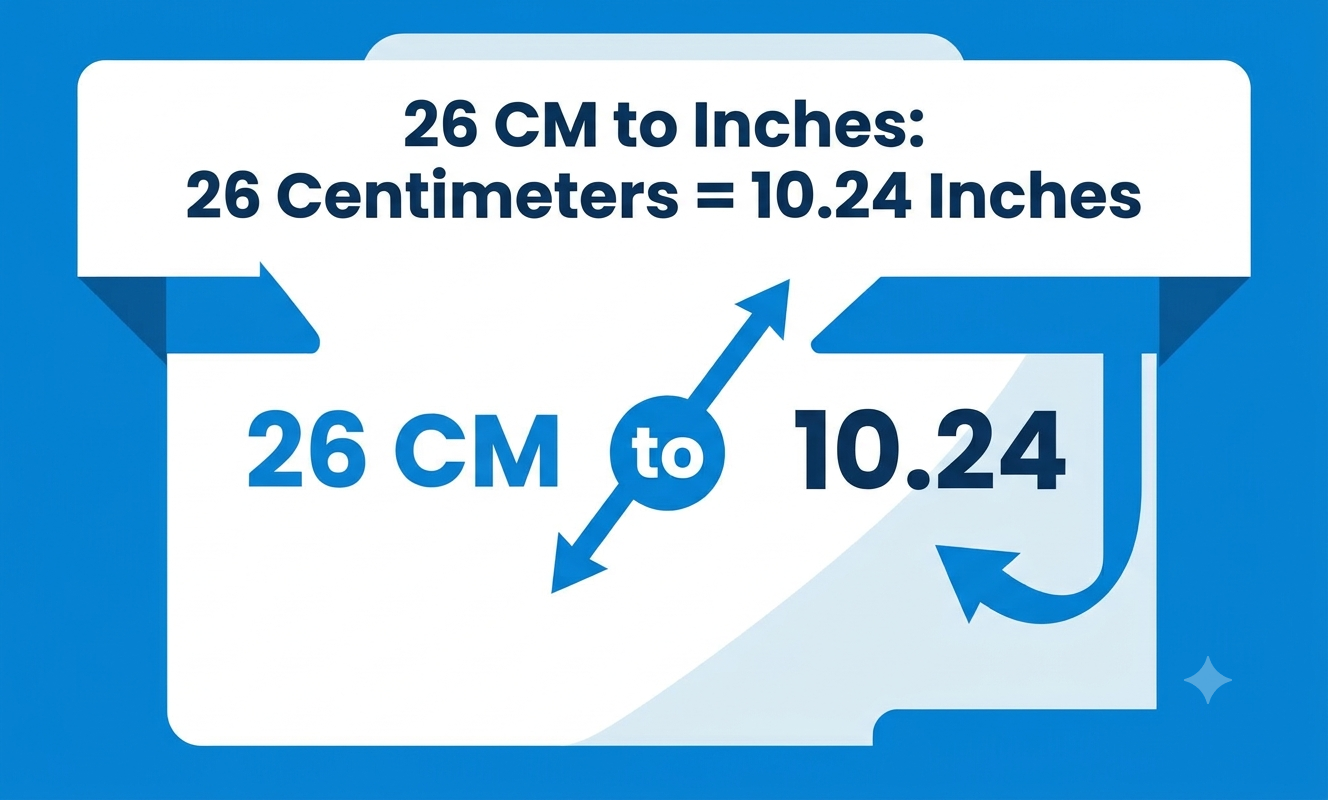
26 cm = 10.24 inches
- Decimal: 10.24 inches
- Fraction: 10 1/4 inches (approx.)
- Feet + Inches: 0 feet 10.24 inches (less than 1 foot)
- Formula: 26 ÷ 2.54 = 10.24
What is 26cm to Inches?
The answer is simple: 26 centimeters equals 10.24 inches. This conversion links two different measurement systems — the metric system (used almost everywhere in the world, including centimeters and meters) and the imperial system (used mainly in the United States, and includes inches and feet). People search for “26cm to inches” when reading product labels from Europe or Asia, checking shoe or clothing sizes, measuring furniture, or completing school math homework. Since most of the world uses centimeters but the US relies on inches, this conversion helps shoppers, students, and DIYers understand sizes without confusion.
How to Convert 26 CM to Inches
The standard rule is: 1 inch = 2.54 centimeters. To convert centimeters to inches, you can either divide or multiply.
Method 1 — Divide by 2.54: 26 cm ÷ 2.54 = 10.24 inches
Method 2 — Multiply by 0.3937: 26 cm × 0.3937 = 10.24 inches
Both methods give the same result because 0.3937 is simply the decimal version of 1 ÷ 2.54. For quick mental math, dividing by 2.5 (instead of 2.54) gets you close: 26 ÷ 2.5 = 10.4, which is a fast estimate before you calculate the exact number. For anything that needs precision — like sewing, construction, or science homework — always use the full 2.54 conversion factor.
Real-World Examples: What Does 26 CM Look Like?
- A large men’s shoe: A men’s US size 10-11 shoe is roughly 26 cm long, making this a common size chart reference point.
- A standard laptop: Many 13-inch laptops are close to 26–30 cm wide, so this measurement helps when checking if a laptop fits a bag.
- A dinner plate: Many dinner plates measure around 26 cm across, which is why this size shows up often in kitchenware listings.
- A large tablet or e-reader: Bigger tablets, like 10-11 inch models, come close to 26 cm in height when measured diagonally in some cases.
- A ruler and a half: Since a standard school ruler is 30 cm, 26 cm is a bit shorter — about 87% of a full ruler’s length.
- A baby’s growth milestone: Newborn head circumference is sometimes recorded near 26 cm at the smaller end of the normal range, which is why parents may search this conversion.
Practical Use Cases
- DIY & Home Improvement
If you’re measuring a shelf gap, a picture frame, or a piece of trim that’s listed as 26 cm, you now know it equals 10.24 inches — just under 11 inches. This matters when your tape measure only shows inches. Round up slightly to 10 1/4″ when cutting wood or materials, and always double-check with a metric tape if precision matters for a tight fit.
- Fashion & Clothing / Shopping
Shoe lengths, bag widths, and belt sizes from international retailers are often listed in centimeters. A 26 cm measurement is common for shoe insoles and mid-size handbags. Knowing it equals 10.24 inches helps US shoppers compare sizes accurately before buying from European or Asian websites, avoiding returns due to sizing mistakes.
- School, Science & Math
Students often need to convert 26 cm to inches for geometry, physics, or lab reports that mix metric and imperial units. Understanding that 26 cm = 10.24 inches (or roughly 10 1/4″) helps with graphing, unit conversion homework, and science experiments that require accurate measurement reporting in both systems.
Nearby Conversions Table
| CM | Inches (Decimal) | Fraction | Feet |
|---|---|---|---|
| 21 cm | 8.27 in | 8 1/4″ | 0.69 ft |
| 22 cm | 8.66 in | 8 11/16″ | 0.72 ft |
| 23 cm | 9.06 in | 9 1/16″ | 0.75 ft |
| 24 cm | 9.45 in | 9 7/16″ | 0.79 ft |
| 25 cm | 9.84 in | 9 13/16″ | 0.82 ft |
| 26 cm | 10.24 in | 10 1/4″ | 0.85 ft |
| 27 cm | 10.63 in | 10 5/8″ | 0.89 ft |
| 28 cm | 11.02 in | 11″ | 0.92 ft |
| 29 cm | 11.42 in | 11 7/16″ | 0.95 ft |
| 30 cm | 11.81 in | 11 13/16″ | 0.98 ft |
| 31 cm | 12.20 in | 12 3/16″ | 1.02 ft |
Frequently Asked Questions
Q: How many inches is 26 cm? A: 26 cm equals 10.24 inches. You get this by dividing 26 by 2.54, the number of centimeters in one inch.
Q: What is 26 cm in inches as a fraction? A: 26 cm is approximately 10 1/4 inches when rounded to the nearest common fraction. The exact decimal is 10.2362, which rounds cleanly to a quarter inch.
Q: Is 26 cm equal to how many feet and inches? A: 26 cm is 0 feet and 10.24 inches, since it’s shorter than one foot (which is 30.48 cm). It’s just under 11 inches total.
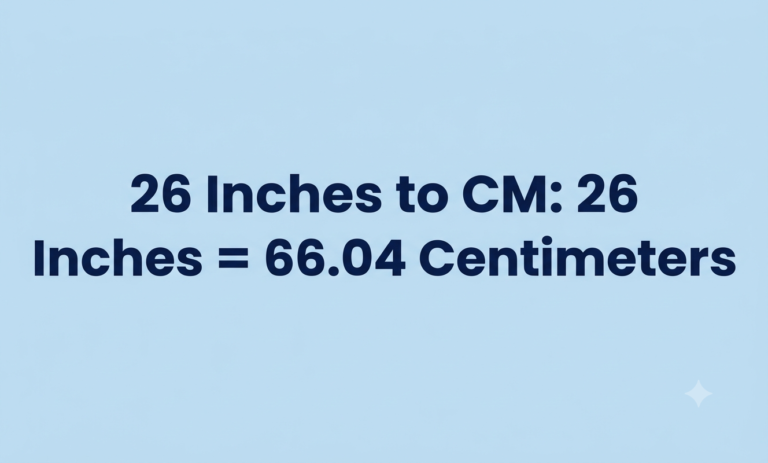
Q: How do you convert 26 inches to cm instead? A: To reverse it, multiply by 2.54: 26 inches × 2.54 = 66.04 cm. This is the opposite direction of the cm-to-inches formula.
Q: Is 26 cm more than 10 inches? A: Yes. 26 cm (10.24 inches) is slightly more than 10 inches. The difference is about a quarter of an inch, or 0.24 inches.
Q: What everyday object is about 26 cm long? A: A large men’s shoe (around US size 10-11) or a standard dinner plate is close to 26 cm, making it a helpful mental reference for this length.
Tips for Converting CM to Inches
- Quick estimate trick: Divide by 2.5 instead of 2.54 for a fast mental estimate — it’s close enough for casual use, though not for precise work.
- Use decimals for math, fractions for tools: Decimals (10.24″) are best for calculators and spreadsheets, while fractions (10 1/4″) are easier to read on a physical ruler or tape measure.
- Avoid rounding too early: Rounding 26 ÷ 2.54 before completing the calculation can throw off your final answer — always divide first, then round.
- Don’t confuse cm with mm: Millimeters are 10x smaller than centimeters, so double-check your unit before converting to avoid a measurement that’s off by a factor of ten.
- Use an online calculator for precision: For construction, sewing, or lab work, a digital cm-to-inches calculator avoids human error and gives results to more decimal places than mental math.
Conclusion
To sum it up, 26 cm equals 10.24 inches (or about 10 1/4 inches), calculated using the formula 26 ÷ 2.54. Whether you’re shopping for shoes, working on a DIY project, or finishing homework, this quick reference makes switching between metric and imperial measurements simple. Bookmark this page so you always have the exact answer on hand.