Quick Answer Box
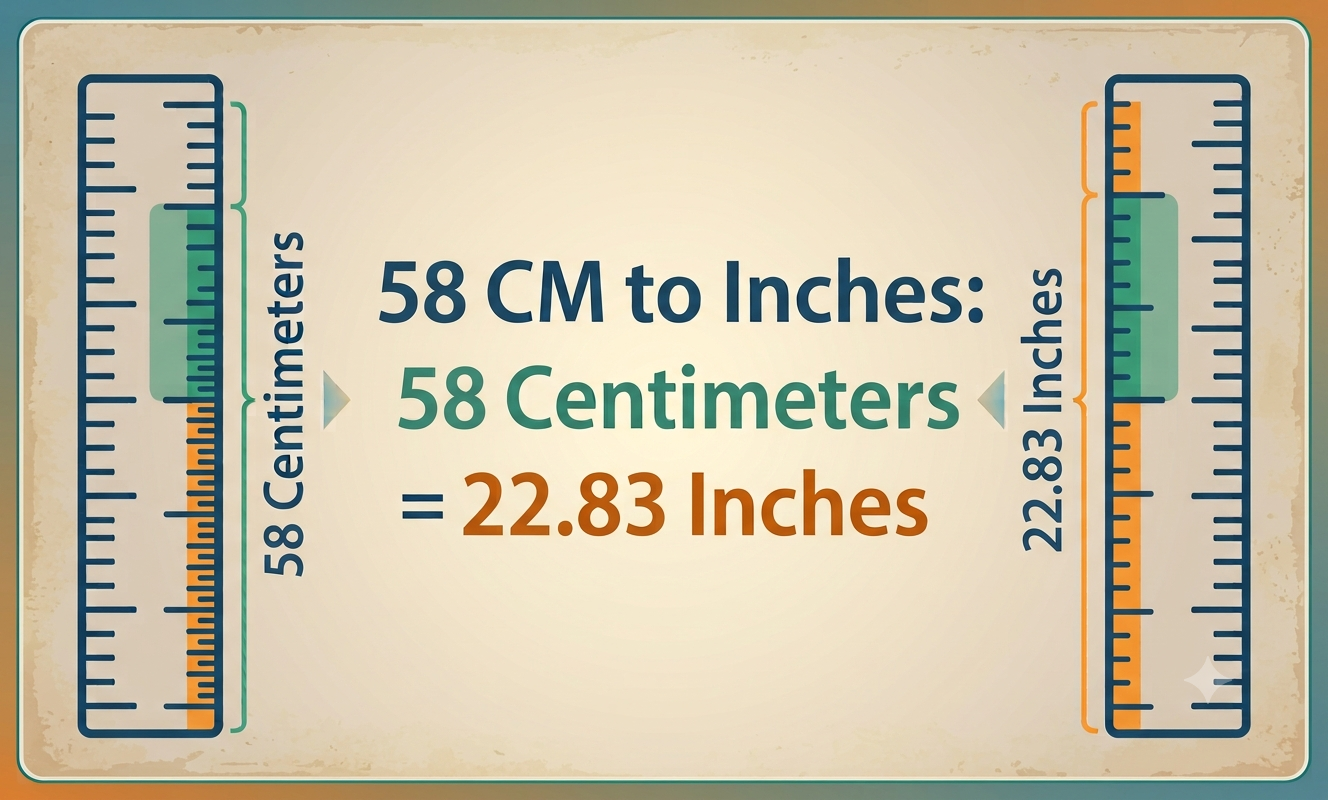
58 cm = 22.8346 inches
- Decimal: 22.83 inches
- Fraction (approx.): 22 ¹³⁄₁₆ inches
- Feet + Inches: 1 foot 10.83 inches
- Formula: 58 ÷ 2.54 = 22.8346 inches
What is 58 CM to Inches?
58 centimeters equals 22.83 inches, or roughly 1 foot and 10.83 inches. Centimeters belong to the metric system, used in most countries around the world. Inches belong to the imperial system, still common in the United States, United Kingdom, and Canada for everyday measurements. You might need this conversion when shopping for clothing online, checking product dimensions, working on a DIY project, or helping a student with homework. Knowing how to go between these two units makes life a lot easier.
How to Convert 58 CM to Inches
Converting centimeters to inches is simple once you know the key number: 1 inch = 2.54 centimeters.
- Method 1 — Divide by 2.54 (Most Common)
$$58 \div 2.54 = 22.8346 \text{ inches}$$
Step by step:
- Take your value: 58
- Divide by 2.54
- Result: 22.8346 inches (round to 22.83)
- Method 2 — Multiply by 0.3937
$$58 \times 0.3937 = 22.8346 \text{ inches}$$
Both methods give the same result. Division is easier to remember because 2.54 is the exact definition of an inch. For quick mental math, you can also multiply by 0.4 and get a close estimate: 58 × 0.4 = 23.2 (slightly over, but good enough for rough estimates).
Real-World Examples: What Does 58 CM Look Like?
- 📏 A Standard Carry-On Bag
Most airline carry-on bags have a height of around 55–60 cm. A bag that is 58 cm tall fits neatly in that range. That’s roughly 22.83 inches from base to top handle — just under the limit for many airlines.
- 👕 Men’s Shirt Width (XL Size)
A men’s extra-large dress shirt often measures about 58 cm across the chest when laid flat. When shopping internationally, knowing this equals 22.83 inches helps you match sizes without confusion.
- 📐 Large Laptop Screen Diagonal
Some large laptop screens or monitors measure their diagonal around 58 cm. That works out to approximately 22.8 inches, which falls right into the popular 23-inch monitor category.
- 🎸 Half the Length of a Guitar
A standard acoustic guitar is about 100–105 cm long. Fifty-eight centimeters is a little more than half that length — handy for visualizing the size if you’re packing or shipping an instrument.
- 🧒 Height of a Toddler
A typical child around 12–14 months old stands roughly 75–80 cm tall. At 58 cm, you’re looking at the height of a newborn to very young infant — useful context for baby clothing or furniture shopping.
- 🖼️ Picture Frame Size
A 58 cm dimension on a picture frame equals about 22.83 inches. This is close to standard poster frame sizes (18×24 inches or 20×24 inches), so it’s a useful conversion for home décor projects.
Practical Use Cases
- DIY & Home Improvement
When you’re cutting timber, measuring tile, or hanging shelves, the measurement 58 cm comes up often — especially with European-made materials that use metric sizing. Converting to 22.83 inches lets you use standard US measuring tapes and rulers. For example, if a flat-pack furniture shelf is listed as 58 cm wide, you now know it will fit in a space that is at least 23 inches wide. Always add a small buffer of half an inch when measuring for a snug fit.
- Fashion & Clothing / Shopping
Online clothing stores in Europe, Asia, and South America often list measurements in centimeters. A waist measurement of 58 cm converts to approximately 22.83 inches, which typically falls in the XS to S range for many women’s clothing brands. When shopping internationally, use this conversion to match your local size chart. It’s also useful for checking sleeve lengths, inseam measurements, and chest widths when ordering from foreign retailers.
- School, Science & Math
In science class, students often need to convert between metric and imperial units. 58 cm to inches is a great practice problem because the answer — 22.8346 inches — shows how to use division with decimals. Teachers often ask students to express the answer both in decimal (22.83) and fraction form (22 ¹³⁄₁₆ inches). This conversion also illustrates why the metric system is precise and consistent: one simple number (2.54) is all you need.
Nearby Conversions
| Centimeters (cm) | Inches (decimal) | Inches (fraction) | Feet & Inches |
|---|---|---|---|
| 53 cm | 20.87 in | 20 ⁷⁄₈ in | 1 ft 8.87 in |
| 54 cm | 21.26 in | 21 ¼ in | 1 ft 9.26 in |
| 55 cm | 21.65 in | 21 ⅝ in | 1 ft 9.65 in |
| 56 cm | 22.05 in | 22 ¹⁄₁₆ in | 1 ft 10.05 in |
| 57 cm | 22.44 in | 22 ⁷⁄₁₆ in | 1 ft 10.44 in |
| 58 cm | 22.83 in | 22 ¹³⁄₁₆ in | 1 ft 10.83 in |
| 59 cm | 23.23 in | 23 ¼ in | 1 ft 11.23 in |
| 60 cm | 23.62 in | 23 ⅝ in | 1 ft 11.62 in |
| 61 cm | 24.02 in | 24 ¹⁄₃₂ in | 2 ft 0.02 in |
| 62 cm | 24.41 in | 24 ⅜ in | 2 ft 0.41 in |
| 63 cm | 24.80 in | 24 ¹³⁄₁₆ in | 2 ft 0.80 in |
Frequently Asked Questions
Q: How many inches is 58 cm? A: 58 cm equals 22.8346 inches, which is typically rounded to 22.83 inches. You get this by dividing 58 by 2.54, since there are exactly 2.54 centimeters in one inch.
Q: What is 58 cm in inches as a fraction? A: 58 cm in fraction form is approximately 22 ¹³⁄₁₆ inches. The decimal 22.8346 converts to a fraction by looking at the closest common fraction — 13/16 equals 0.8125, which is the nearest standard fraction to 0.8346.
Q: What is 58 cm in feet and inches? A: 58 cm equals 1 foot and 10.83 inches. Here’s how: first convert to total inches (22.83), then divide by 12 to get 1 full foot, with 10.83 inches remaining.
Q: How much is 22.83 inches in centimeters? A: 22.83 inches equals approximately 58 cm. To reverse the conversion, multiply inches by 2.54: 22.83 × 2.54 = 57.99 cm, which rounds back to 58 cm.
Q: Is 58 cm more than 23 inches? A: No — 58 cm is slightly less than 23 inches. 58 cm = 22.83 inches, while 23 inches = 58.42 cm. The difference is small (about 0.17 inches or 0.42 cm), but it matters for precision tasks like woodworking or tailoring.
Q: What common object is about 58 cm? A: A standard carry-on suitcase, a large laptop monitor diagonal, or a men’s XL shirt chest width are all close to 58 cm (about 22.83 inches). It’s also roughly the length of a typical school ruler doubled — most rulers are 30 cm, so two of them placed end to end come close to 60 cm.
Tips for Converting CM to Inches
- Mental math shortcut: Multiply centimeters by 0.4 for a fast rough estimate. For 58 cm: 58 × 0.4 = 23.2 inches. This is slightly high but useful when you need a quick ballpark number.
- Use decimal for precision, fractions for shopping: When doing math or science, stick with the decimal 22.83. When buying clothes or frames, use the fraction 22 ¹³⁄₁₆ inches — it’s easier to match against packaged sizes.
- Avoid this common mistake: Don’t multiply by 2.54 when going from cm → inches. That gives you more centimeters, not inches. Always divide by 2.54 to convert cm to inches, and multiply by 2.54 to go the other way.
- Remember the anchor number: The only number you need to memorize is 2.54 — the number of centimeters in one inch. Every other conversion follows from this single fact.
- Use an online calculator: For high-stakes measurements (ordering custom furniture, international shipping, tailoring), use a trusted online converter or your phone’s built-in calculator to double-check. A small rounding error can make a big difference in practical applications.
Related Conversions
- 55 cm to inches — 21.65 inches
- 56 cm to inches — 22.05 inches
- 57 cm to inches — 22.44 inches
- 59 cm to inches — 23.23 inches
- 60 cm to inches — 23.62 inches
- 58 inches to cm — 147.32 centimeters
- 58 cm to feet — 1.903 feet
- 58 cm to mm — 580 millimeters
- 58 cm to meters — 0.58 meters
- 58 cm to yards — 0.634 yards
- cm to inches converter — general metric to imperial tool
Conclusion
58 centimeters equals 22.83 inches, or 1 foot and 10.83 inches — a quick and useful conversion for shopping, DIY projects, school, and more. Just remember: divide by 2.54 and you’ll always get the right answer. Bookmark this page so you can come back whenever you need fast, accurate unit conversions.