
Quick Answer Box
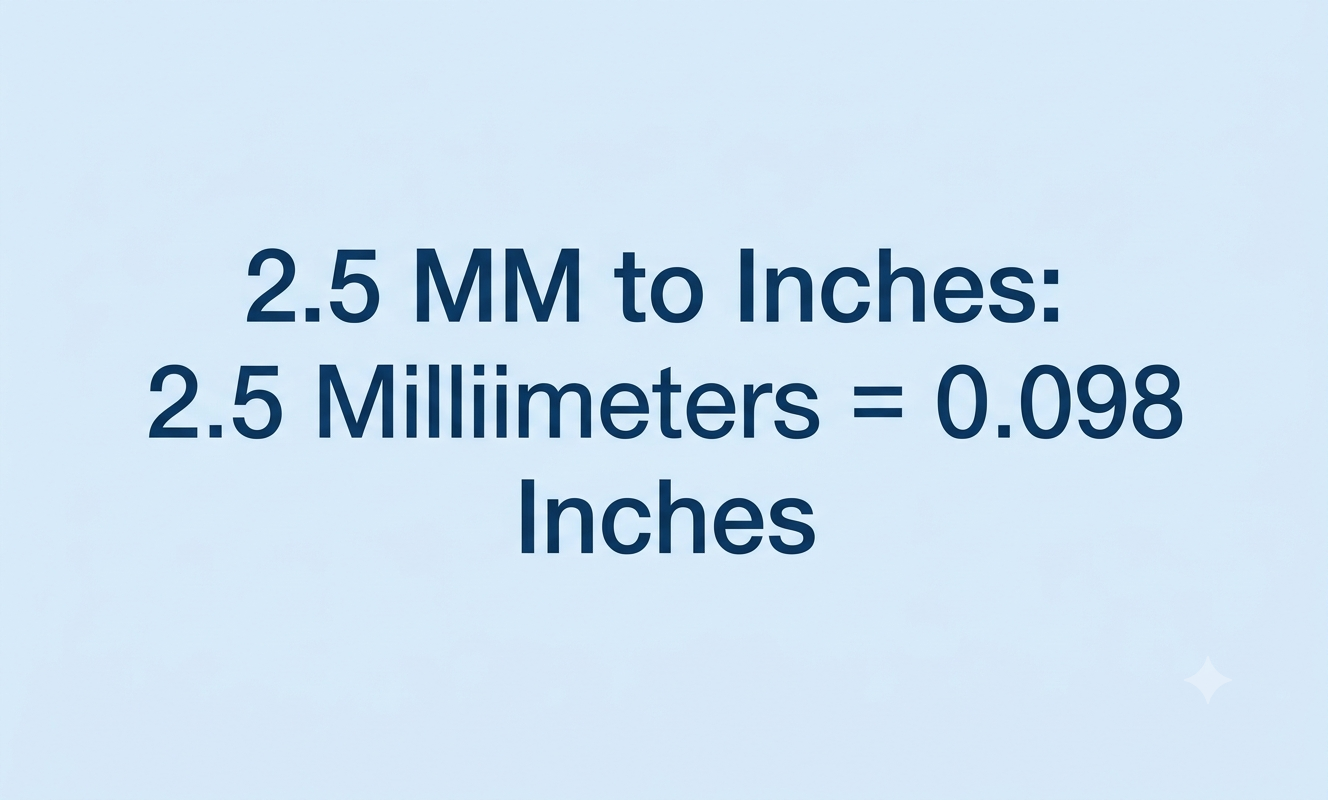
2.5 mm = 0.0984 inches
Fraction: ≈ 3/32 inch (closest standard fraction)
Feet: 0.0082 ft (too small to express meaningfully in feet)
Formula: 2.5 mm ÷ 25.4 = 0.0984 inches
What is 2.5 mm to Inches?
2.5 millimeters equals 0.0984 inches, or roughly 3/32 of an inch. This conversion connects the metric system (millimeters, used across most of the world for precise measurements) with the imperial system (inches, standard in the US for everyday measuring). People search “2.5 mm to inches” most often when reading a screw or drill bit size, checking a jewelry or watch part specification, sizing wire or cable diameter, or converting a medical or scientific measurement from a product label printed in millimeters.
How to Convert Millimeters to Inches
The standard conversion factor is: 1 inch = 25.4 millimeters (this is an exact, internationally defined value).
Method 1 — Divide by 25.4:
2.5 mm ÷ 25.4 = 0.0984 inches
Method 2 — Multiply by the inverse factor (0.03937):
2.5 mm × 0.03937 = 0.0984 inches
Both methods give the same result. Dividing by 25.4 is easiest to remember since it’s the direct definition of an inch. If you’re converting many small millimeter values regularly (like reading a metric ruler in inches), multiplying by 0.0394 is often faster on a calculator because it avoids long division.
Real-World Examples: What Does 2.5 mm Look Like?
- A pencil lead: Standard mechanical pencil lead is 0.5–0.9 mm, but a thick lead pencil or fine-point marker tip can measure close to 2.5 mm in diameter.
- A small earring post: Many stud earring posts and jewelry pins measure around 2.5 mm thick — this is why jewelers often reference this exact size.
- A guitar string gauge: Heavier bass guitar strings can reach 2.5 mm, roughly matching the thickness of a thick rubber band.
- A grain of rice: A single grain of white rice is roughly 2–3 mm wide, making 2.5 mm a familiar “tiny object” benchmark.
- A small drill bit: A 2.5 mm drill bit (close to a US #40 bit) is common for pilot holes in wood and light metal.
- Credit card thickness: A standard credit card is about 0.76 mm thick, so 2.5 mm is roughly three stacked credit cards.
Practical Use Cases
DIY & Home Improvement
A 2.5 mm measurement most often shows up as a drill bit size, hex key (Allen wrench) size, or screw diameter on hardware packaging. If your project calls for a 2.5 mm bit and your toolbox only shows inches, reach for the closest match: a 3/32-inch bit is the nearest imperial equivalent, though it’s very slightly larger than true 2.5 mm.
Fashion & Clothing / Shopping
Jewelry listings — especially earring posts, small chain links, and thin bracelet clasps — commonly list dimensions in millimeters. A 2.5 mm clasp or post is considered thin and delicate. When shopping on US sites that use inches, knowing that 2.5 mm equals about 0.1 inch helps you judge whether a piece will look substantial or subtle before buying.
School, Science & Math
Students frequently convert millimeters to inches in geometry, physics, and chemistry lab work, especially when using a dual-scale ruler. 2.5 mm is a common answer in worksheet problems because it converts to a clean, teachable fraction (3/32 inch), making it a good example for practicing metric-to-imperial conversion skills.
Nearby Conversions Table
| Millimeters (mm) | Inches (decimal) | Fraction (approx.) | Feet (decimal) |
|---|---|---|---|
| 1.25 mm | 0.0492 in | 3/64″ | 0.0041 ft |
| 1.5 mm | 0.0591 in | 1/16″ | 0.0049 ft |
| 1.75 mm | 0.0689 in | 1/16″ | 0.0057 ft |
| 2.0 mm | 0.0787 in | 5/64″ | 0.0066 ft |
| 2.25 mm | 0.0886 in | 3/32″ | 0.0074 ft |
| 2.5 mm | 0.0984 in | 3/32″ | 0.0082 ft |
| 2.75 mm | 0.1083 in | 7/64″ | 0.0090 ft |
| 3.0 mm | 0.1181 in | 1/8″ | 0.0098 ft |
| 3.25 mm | 0.1280 in | 1/8″ | 0.0107 ft |
| 3.5 mm | 0.1378 in | 9/64″ | 0.0115 ft |
| 3.75 mm | 0.1476 in | 9/64″ | 0.0123 ft |
Frequently Asked Questions
Q: How many inches is 2.5 mm?
A: 2.5 mm equals 0.0984 inches, which rounds to about 0.1 inches. You get this by dividing 2.5 by 25.4.
Q: What is 2.5 mm as a fraction of an inch?
A: The closest standard fraction is 3/32 inch (0.09375 inches). It’s not a perfect match, but it’s the nearest fraction commonly found on a US ruler or in a drill bit set.
Q: Is 2.5 mm equal to any usable feet measurement?
A: Technically yes — 2.5 mm equals 0.0082 feet — but this is far too small to be practical. Feet are almost never used for measurements this tiny.
Q: How do I convert 2.5 inches back to mm?
A: That’s a different value entirely — 2.5 inches equals 63.5 mm (2.5 × 25.4). Don’t confuse “2.5 mm to inches” with “2.5 inches to mm”; they’re opposite conversions with very different results.
Q: Is 2.5 mm bigger or smaller than 1/8 inch?
A: 2.5 mm (0.098 in) is smaller than 1/8 inch (0.125 in). 1/8 inch actually equals about 3.18 mm, so there’s a noticeable size difference between the two.
Q: What everyday object is about 2.5 mm thick?
A: A thick guitar string, a jewelry earring post, or roughly three stacked credit cards are all close to 2.5 mm — useful mental benchmarks if you don’t have a ruler handy.
Tips for Converting Millimeters to Inches
- Quick mental math: Divide the mm value by 25 (not 25.4) for a fast estimate — 2.5 ÷ 25 = 0.1 inches, which is very close to the real answer of 0.0984.
- Use decimals for tools and machining, where precision matters (drill bits, calipers). Use fractions for everyday reference, like reading a tape measure.
- Common mistake: Don’t confuse mm with cm. 2.5 cm is ten times larger than 2.5 mm (2.5 cm = 25 mm), so double-check which unit your source is actually using.
- Rounding trap: Rounding 0.0984 to “0.1 inches” is fine for casual use, but for jewelry, drill bits, or engineering specs, keep the full decimal to avoid a size mismatch.
- Use an online calculator for repeated or bulk conversions — it removes rounding errors and saves time compared to manual division.
Conclusion
2.5 mm converts to 0.0984 inches, or approximately 3/32 of an inch — a size roughly equal to a thick jewelry post or a small drill bit. Whether you’re shopping, doing DIY repairs, or finishing homework, this simple formula (divide by 25.4) works for any millimeter-to-inch conversion. Bookmark this page for quick reference next time you need it.
Also read 16 Feet in Inches: 16 Feet = 192 Inches


One Comment