
Quick Answer Box
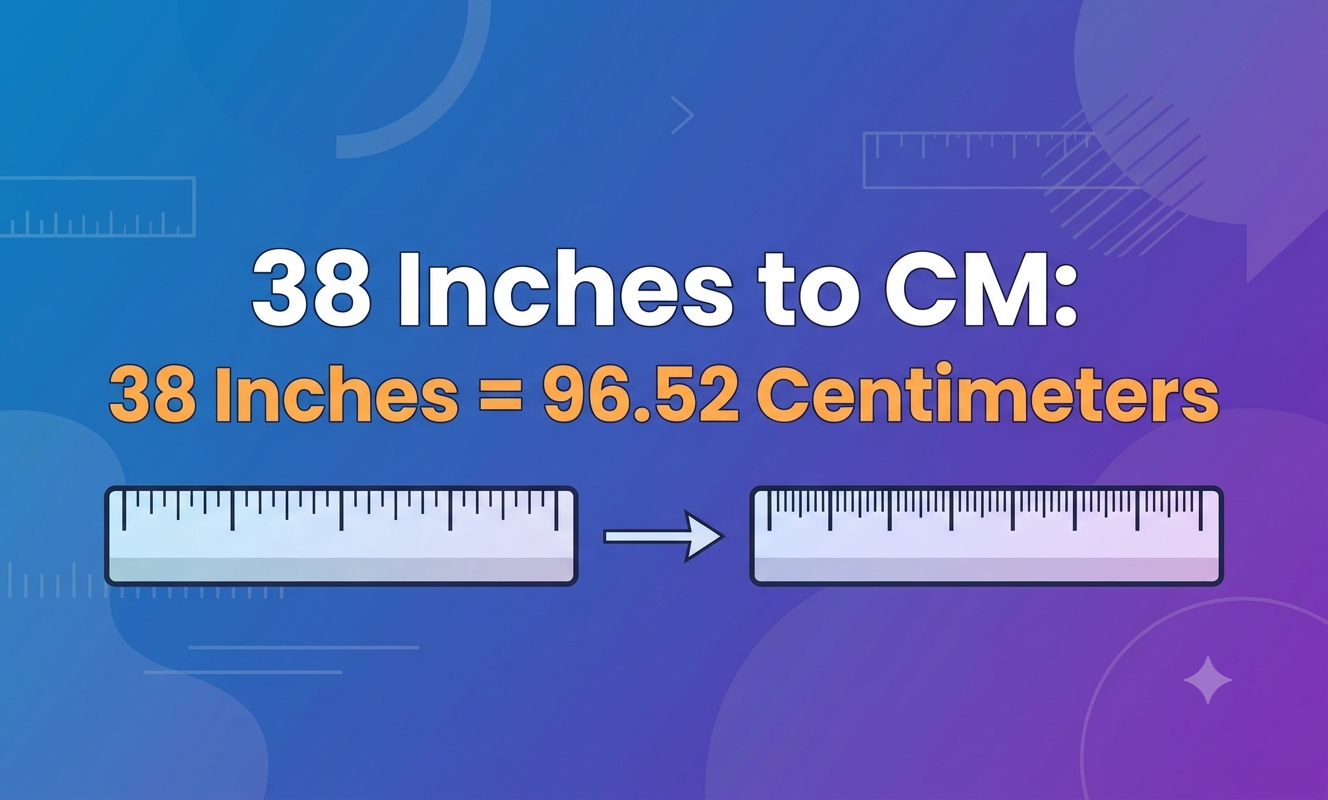
38 inches = 96.52 cm
- Decimal format: 96.52 cm
- Fraction format: 96 ½ cm (approx.)
- Feet + inches format: 3 feet 2 inches
- Formula: 38 × 2.54 = 96.52
What is 38 Inches to CM?
38 inches equals 96.52 centimeters. This conversion moves a measurement from the imperial system (used mainly in the US) to the metric system (used almost everywhere else, including the UK, Europe, and most of Asia). People search for 38 inches to cm when buying furniture, checking luggage or TV sizes, reading clothing measurements, or completing school math homework. Since most of the world uses centimeters, this conversion helps US shoppers understand product listings from international websites, and it helps international buyers understand US-made products sized in inches.
How to Convert Inches to CM
Converting inches to centimeters uses one simple formula:
Inches × 2.54 = Centimeters
For 38 inches, the math is:
38 × 2.54 = 96.52 cm
Step-by-step:
- Take the inch value: 38
- Multiply by the conversion factor: 2.54
- Result: 96.52 cm
Reverse method (cm to inches): If you already have the centimeter value and want inches back, divide by 2.54: 96.52 ÷ 2.54 = 38 inches
Both methods confirm the same answer, so you can double-check your work either way. This 2.54 factor never changes — it’s the fixed relationship between one inch and one centimeter.
Real-World Examples: What Does 38 Inches Look Like?
- A carry-on suitcase: Many airline carry-on bags are close to 38 inches (96.52 cm) in total dimensions (length + width + height combined).
- A bar stool or countertop height: Kitchen counters and bar-height tables often sit around 38 inches tall — a familiar everyday reference point.
- A toddler’s height: A child around 3 years old typically measures close to 38 inches, making this a common pediatric growth chart figure.
- A guitar: Many full-size acoustic guitars measure roughly 38–41 inches in total length.
- A narrow doorway or hallway width: Some interior doorways measure close to 38 inches wide.
- A yard of fabric plus a bit more: Since 1 yard = 36 inches, 38 inches is just over a yard — useful for sewing and quilting projects.
Practical Use Cases
DIY & Home Improvement
If you’re building a bar-height table, installing a countertop, or framing a doorway, 38 inches (96.52 cm) is a common target height or width. Converting to centimeters matters when your tape measure, tools, or imported materials use the metric scale. Getting this conversion right avoids costly cutting mistakes on wood, tile, or cabinetry.
Fashion & Clothing / Shopping
Clothing retailers — especially international ones — often list measurements in centimeters. If a size chart shows a waist, bust, or inseam of 38 inches, you’ll see it listed as 96.52 cm on European or Asian websites. Knowing this conversion helps you order the correct size the first time and avoid returns.
School, Science & Math
Students learning the metric system often practice converting inches to centimeters in geometry or physical science class. A question like “convert 38 inches to cm” tests the multiplication method (× 2.54) and helps build number sense for real-world measurement problems, from lab reports to word problems.
Nearby Conversions Table
| Inches | CM (decimal) | Fraction (approx.) | Feet + Inches |
|---|---|---|---|
| 33 in | 83.82 cm | 83 ⅚ cm | 2 ft 9 in |
| 34 in | 86.36 cm | 86 ⅓ cm | 2 ft 10 in |
| 35 in | 88.90 cm | 88 ⁹⁄₁₀ cm | 2 ft 11 in |
| 36 in | 91.44 cm | 91 ⅖ cm | 3 ft 0 in |
| 37 in | 93.98 cm | 94 cm | 3 ft 1 in |
| 38 in | 96.52 cm | 96 ½ cm | 3 ft 2 in |
| 39 in | 99.06 cm | 99 cm | 3 ft 3 in |
| 40 in | 101.60 cm | 101 ⅗ cm | 3 ft 4 in |
| 41 in | 104.14 cm | 104 ⅐ cm | 3 ft 5 in |
| 42 in | 106.68 cm | 106 ⅔ cm | 3 ft 6 in |
| 43 in | 109.22 cm | 109 ⅕ cm | 3 ft 7 in |
Frequently Asked Questions
Q: How many cm is 38 inches? A: 38 inches equals 96.52 cm. You get this by multiplying 38 by 2.54, the fixed inch-to-centimeter conversion factor.
Q: What is 38 inches as a fraction in cm? A: In fraction form, 38 inches is approximately 96 ½ cm. Since centimeters are decimal-based, exact fractions are less common, but rounding to the nearest half or quarter cm is standard practice.
Q: How many feet is 38 inches? A: 38 inches equals 3 feet 2 inches. Since 1 foot = 12 inches, 36 inches makes exactly 3 feet, leaving 2 inches over.
Q: How many cm is 38 inches, and how do I convert cm back to inches? A: 38 inches = 96.52 cm. To reverse it, divide the centimeter value by 2.54, so 96.52 ÷ 2.54 brings you back to exactly 38 inches.
Q: Is 96.52 cm more than 38 inches? A: No — 96.52 cm and 38 inches are the exact same length, just expressed in different measurement systems. Neither is “more”; they’re equal values.
Q: What common object is about 38 inches (96.52 cm)? A: A bar-height countertop or a large carry-on suitcase is close to 38 inches (96.52 cm), making it a handy visual reference for this measurement.
Tips for Converting Inches to CM
- Quick mental math trick: Round 2.54 to 2.5 for a fast estimate — 38 × 2.5 = 95, then add a small adjustment (~0.5 cm per inch) to get closer to the true 96.52 cm.
- Use decimals for precision, fractions for everyday speech: Decimals (96.52 cm) are best for construction, sewing, or science; fractions (96 ½ cm) work fine for casual conversations.
- Avoid the common mistake of confusing multiply vs. divide: Multiply inches by 2.54 to get cm. Divide cm by 2.54 to get inches back. Mixing these up is the #1 error people make.
- Don’t round too early: Round only your final answer, not the numbers in the middle of your calculation, or you’ll lose accuracy.
- Use an online calculator for speed: For quick, error-free results — especially with repeated conversions — an online inches-to-cm calculator saves time and prevents rounding mistakes.
Conclusion
38 inches equals 96.52 cm — a conversion useful for shopping, DIY projects, and schoolwork alike. Bookmark this page or share it so you always have the exact answer, formula, and real-world context ready whenever you need to convert inches to centimeters.
Also read 18 Inches of Snow: 18 Inches = 1.5 Feet (45.72 CM) Explained


One Comment