Quick Answer Box
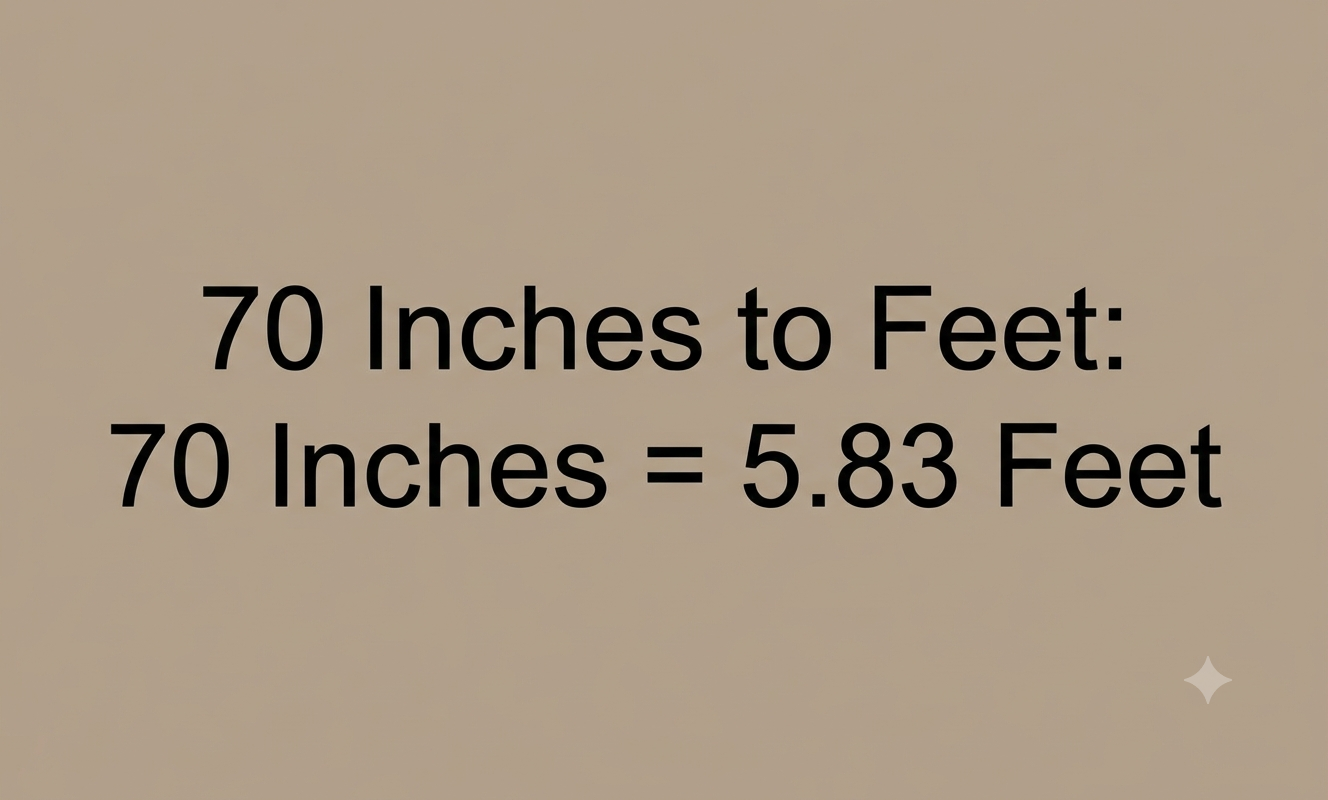
70 inches = 5.83 feet
- Decimal format: 5.83 feet
- Fraction format: 5 5/6 feet
- Feet + inches format: 5 feet 10 inches
- Formula: 70 ÷ 12 = 5.83 feet
What is 70 Inches to Feet?
70 inches equals 5.83 feet, or exactly 5 feet 10 inches. Both inches and feet belong to the imperial measurement system, which is used mainly in the United States and, less commonly, in the United Kingdom. This conversion is used every day by people measuring height, checking furniture or door dimensions, doing DIY projects, or working through school math problems. Since 70 inches falls close to average adult height, this exact conversion is one of the most searched height-related conversions online.
How to Convert 70 Inches to Feet
There are 12 inches in every foot, so converting inches to feet always uses the number 12.
Divide Method (Inches → Feet): 70 inches ÷ 12 = 5.83 feet
Step-by-step:
- Take the inch value: 70
- Divide by 12 (inches per foot): 70 ÷ 12 = 5.8333…
- Round to two decimals: 5.83 feet
- To get feet + inches: 70 ÷ 12 = 5 remainder 10, so 5 feet 10 inches
Multiply Method (Feet → Inches, reverse check): 5.83 feet × 12 = 69.96 inches ≈ 70 inches ✓
This confirms the conversion is correct. The divide method is the fastest way to go from inches to feet, while multiplying by 12 is how you’d go back the other way.
Real-World Examples: What Does 70 Inches Look Like?
- Adult height: 70 inches (5’10”) is a common adult male height in the US — think of an average NBA guard’s teammate, not the tallest player on the team.
- Door height reference: A standard interior door is about 80 inches tall, so 70 inches is roughly 10 inches shorter than a typical doorway.
- Large TV screen: Many big-screen TVs are measured diagonally near 70 inches, giving you a visual sense of the scale for a home theater setup.
- Dining table length: A dining table built for 6 people often runs close to 70 inches long, making it a useful benchmark when shopping for furniture.
- Surfboard length: Many longboard surfboards measure around 70 inches, which helps surfers picture this length outside the house.
- Science class rulers: In a classroom, 70 inches equals almost six standard yardsticks laid end to end, useful for visualizing length in physics or geometry lessons.
Practical Use Cases
DIY & Home Improvement
If you’re installing shelving, curtains, or a room divider, knowing that 70 inches = 5 feet 10 inches helps you plan wall space accurately. Many curtain rods and closet organizer kits are sold in inch measurements, so converting to feet helps you quickly compare against room dimensions listed in a floor plan, which are usually given in feet.
Fashion & Clothing / Shopping
Height-based sizing charts for coats, jumpsuits, or wetsuits often list 70 inches as a cutoff for “tall” sizing. If you’re 5’10”, you’ll fall right at this common breakpoint, so double-checking brand size charts against 70 inches can help you pick between regular and tall fits.
School, Science & Math
Students converting 70 inches to feet in homework often need to show both the decimal (5.83 feet) and mixed-number (5 feet 10 inches) forms. This conversion is a favorite in unit-conversion worksheets because it doesn’t divide evenly, giving students good practice with division and remainders.
Nearby Conversions Table
| Inches | Feet (Decimal) | Feet (Fraction) | Feet + Inches |
|---|---|---|---|
| 65 in | 5.42 ft | 5 5/12 ft | 5 ft 5 in |
| 66 in | 5.50 ft | 5 1/2 ft | 5 ft 6 in |
| 67 in | 5.58 ft | 5 7/12 ft | 5 ft 7 in |
| 68 in | 5.67 ft | 5 2/3 ft | 5 ft 8 in |
| 69 in | 5.75 ft | 5 3/4 ft | 5 ft 9 in |
| 70 in | 5.83 ft | 5 5/6 ft | 5 ft 10 in |
| 71 in | 5.92 ft | 5 11/12 ft | 5 ft 11 in |
| 72 in | 6.00 ft | 6 ft | 6 ft 0 in |
| 73 in | 6.08 ft | 6 1/12 ft | 6 ft 1 in |
| 74 in | 6.17 ft | 6 1/6 ft | 6 ft 2 in |
| 75 in | 6.25 ft | 6 1/4 ft | 6 ft 3 in |
Frequently Asked Questions
Q: How many feet is 70 inches? A: 70 inches equals 5.83 feet, or 5 feet 10 inches when written as feet and inches together. You get this by dividing 70 by 12.
Q: What is 70 inches as a fraction of feet? A: 70 inches equals 5 5/6 feet as a fraction. This comes from 70/12, which simplifies down to 5 whole feet plus 5/6 of a foot.
Q: Is 70 inches the same as 5 feet 10 inches? A: Yes, exactly. 70 inches breaks down evenly into 5 feet (60 inches) plus 10 more inches, giving you 5 feet 10 inches.
Q: How many centimeters is 70 inches? A: 70 inches equals 177.8 centimeters. You get this by multiplying 70 by 2.54, the standard inch-to-centimeter conversion factor.
Q: Is 70 inches taller than 5 feet 9 inches? A: Yes. 70 inches (5’10”) is one inch taller than 5 feet 9 inches (69 inches). It’s a small but noticeable height difference.
Q: What everyday object is about 70 inches long? A: A large dining table for six people or a big-screen TV measured diagonally often comes close to 70 inches, making it a handy real-world reference.
Tips for Converting Inches to Feet
- Quick mental math trick: Divide the inch value by 12; if it doesn’t divide evenly, the remainder is your leftover inches (70 ÷ 12 = 5 remainder 10, so 5 feet 10 inches).
- Use decimals for math and construction, and use feet + inches format when talking about height or everyday measurements — it’s easier for people to picture.
- Common mistake: Don’t confuse dividing by 12 with dividing by 10. Inches convert to feet using 12, not 10, since there are 12 inches in a foot.
- Double-check your remainder: After dividing, multiply the whole number of feet by 12 and subtract from the original inches to confirm your leftover inch count is correct.
- Use an online calculator for fast, error-free results when converting larger or more complex inch values, especially for construction or shopping measurements.
Conclusion
To sum it up, 70 inches equals 5.83 feet, or 5 feet 10 inches in everyday terms. Whether you’re measuring height, furniture, or working through a homework problem, this quick reference makes the conversion simple. Bookmark this page or share it so you always have the answer handy next time you need it.